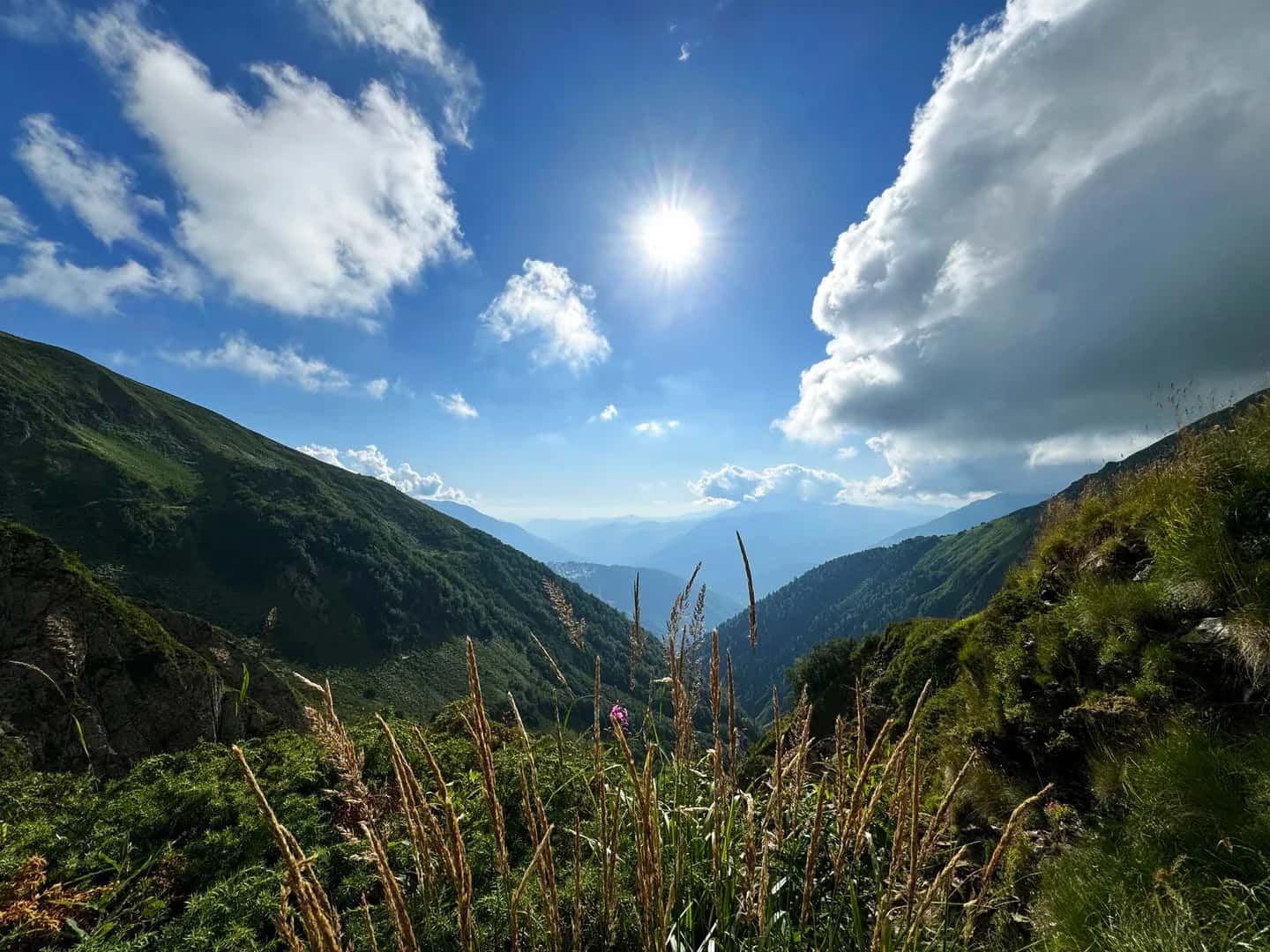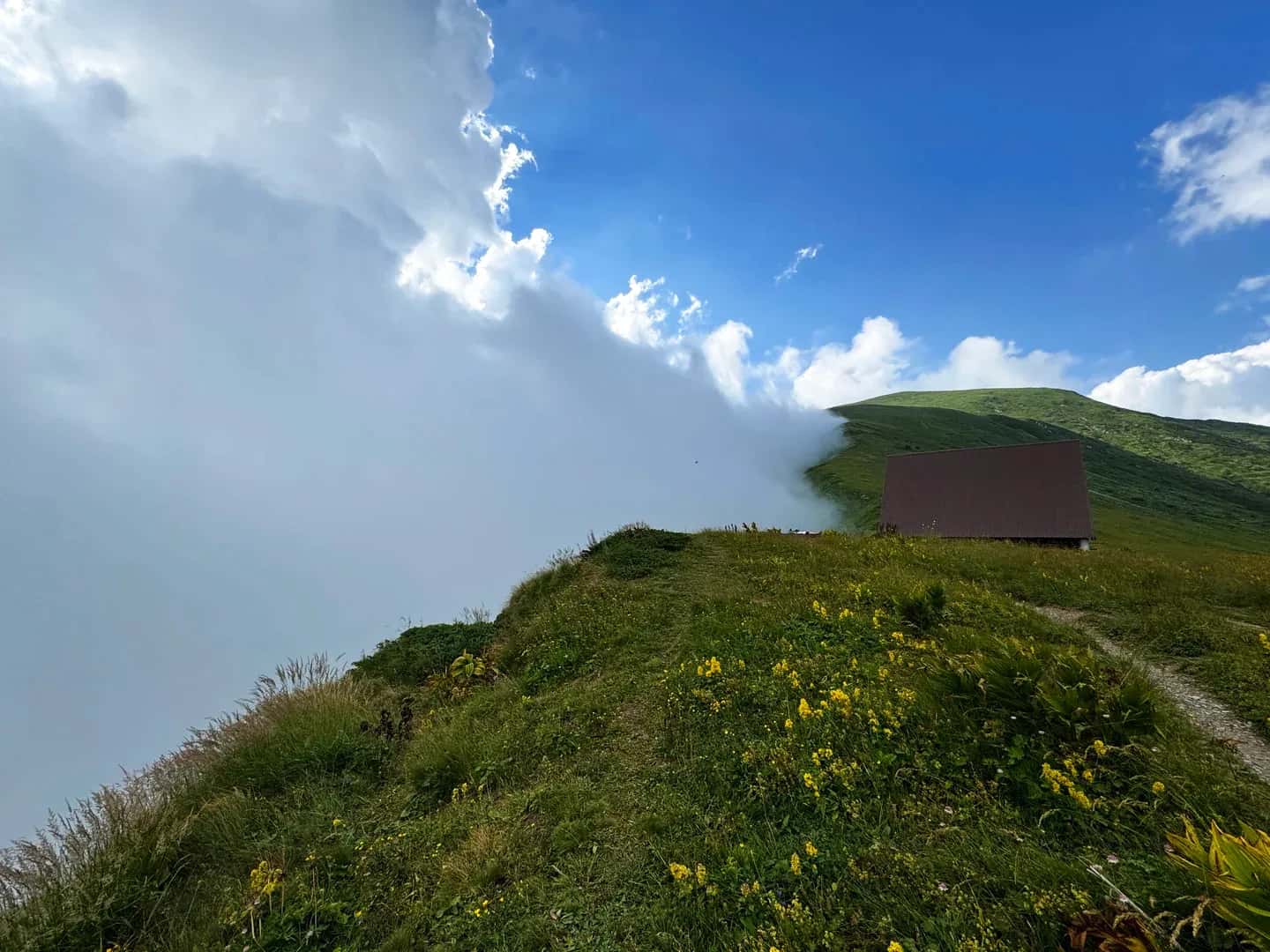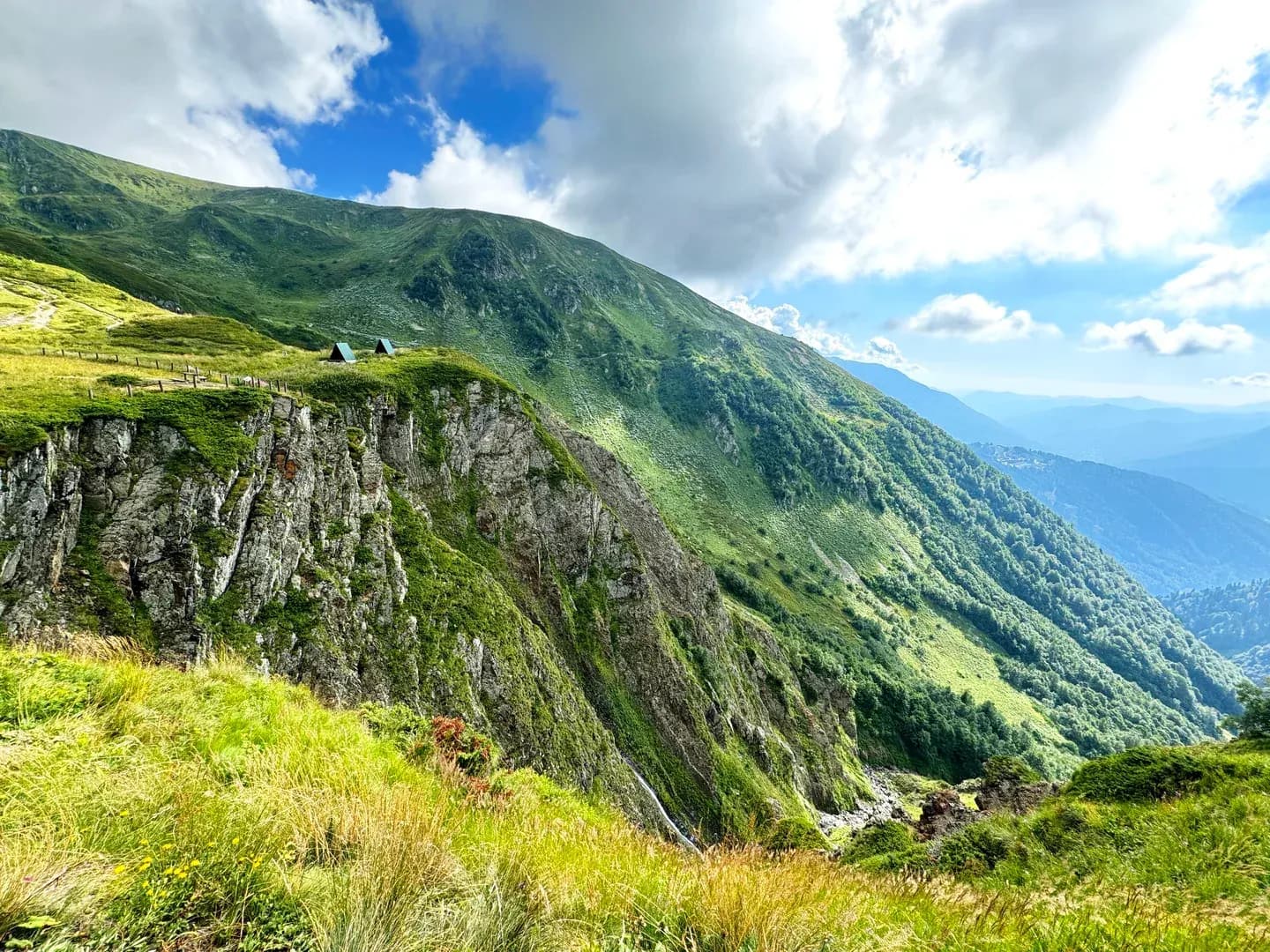
Let us start with the central misunderstanding. The Bzerpinsky cornice is not a peak and not a ridge, but a cliff. The word "cornice" here is a geological term: a rocky ledge overhanging a steep slope, like a cornice above a window. It is from the edge of this cliff that the famous panorama opens - the very thing people come here for.
The cornice stands at 2,063 m (sources vary, roughly 2,050–2,100 m). This is the subalpine belt: the forest is already below you, and around you are meadows, crags and distant snowy ridges.
The cornice is a cliff, not a mountain
The confusion over the name is no accident: there really is a peak nearby - Bzerpi Peak (2,482 m), by Mount Tabunnaya. But the cornice itself is the edge of a plateau, a cliff. That is why, when writing about it, it is correct to say you "come out onto the cornice" or "stand at the edge", rather than "climb to the summit".
This is not pedantry: understanding that what is in front of you is a cliff is directly tied to safety. The edge is unstable, and you should treat it as a cliff, not as a fenced viewing platform. More on this is in the article on trail hazards.
The name "Bzerpi" is ancient. By one account it comes from the Ubykh "bzepi" - "a place by the water"; by another, from the Adyghe bzadzhe - "evil, harsh". Where these names came from is a story of its own, told in the piece on the history and place names of the cornice.
How it was formed
The Western Caucasus is built mainly of sedimentary rock - limestones, sandstones and shales laid down over millions of years. The mountains rose through folding, and the present sharp, jagged relief is the work of ancient glaciation.
The glaciers of past ages ploughed out cirques and corries, smoothed some slopes and cut others into steep walls. Cliffs like the cornice are exactly the trace of such work. And the small mountain lakes nearby (the Dzitaku lakes) lie in glacial basins - classic marks of glaciation.
Where it is in the Mzymta valley
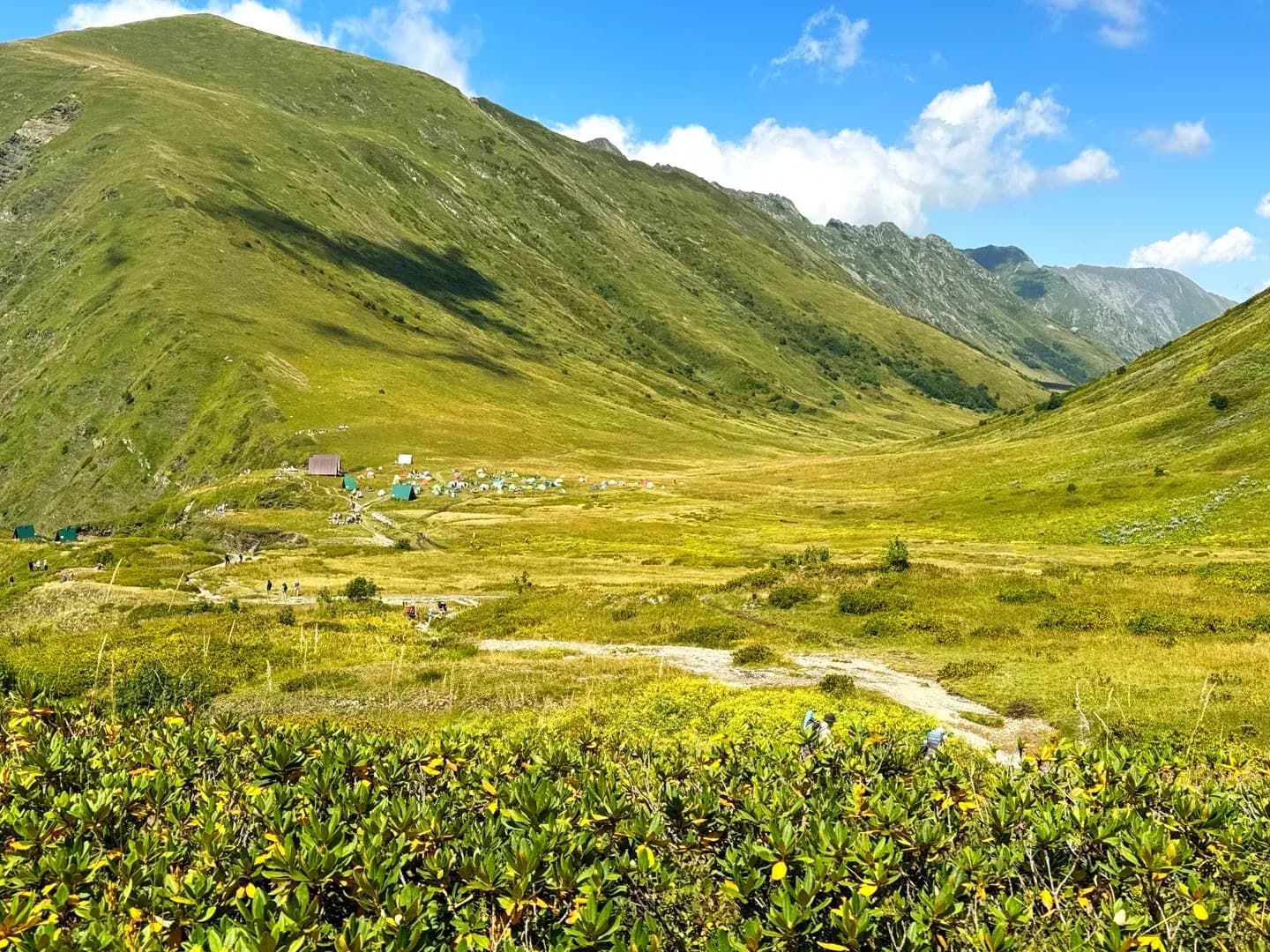
To grasp where the cornice sits, keep a simple model of the area in mind. The Mzymta river flows from east to west and splits the mountains in two. The south side is the Aibga ridge, on which the resorts stand (Rosa Khutor, Alpika, Krasnaya Polyana). The north side is the Psekhako plateau and the Bzerpi massif.
The cornice is on the north side, on the Bzerpi massif. That is why its panorama looks across the Mzymta valley - south to the Aibga ridge, and east towards the high peaks of the Main Caucasus Ridge. Exactly what you can see is covered in a separate article on the views from the cornice.
Quick quiz: what the cornice is

Why people come here at all
Two reasons. The first is the panorama: from a cliff at 2,063 m the view opens for tens of kilometres, over snowy ridges and the valley. The second is accessibility: you can ride up to the start of the trail on the Gazprom Alpika cable car - a single line with no changes to the Pikhtovy shelter, and then on foot. There is no need for several days of approach, as there is for most of the reserve's peaks.
That is exactly why the cornice is one of the most visited spots in the protected zone: high country "for everyone", somewhere you really can do in a single day. The practical details - how to get there, the cable-car timetable - are on commercial resources such as sochiguides.ru; here we are about the place itself.
"The Bzerpinsky cornice belongs to the Caucasus Biosphere Reserve and is one of the most visited places in the protected zone."- site description, Caucasus Nature Reserve
The cornice and the reserve
And one last thing, without which the picture is incomplete: the cornice is part of the Caucasus State Natural Biosphere Reserve, founded in 1924 and inscribed on the UNESCO World Heritage list as "Western Caucasus". You cannot simply walk in - you need permits, and a strict regime applies. Exactly what is and is not allowed is in the article on the reserve rules.
So the Bzerpinsky cornice comes down to a short definition: a rocky cliff at about 2,063 m, on the Bzerpi massif, in the Caucasus Nature Reserve, with a panorama of the Main Caucasus Ridge. The rest of the "Journal" articles are the details: the climate, the views, the flora, the fauna, the history and the rules.