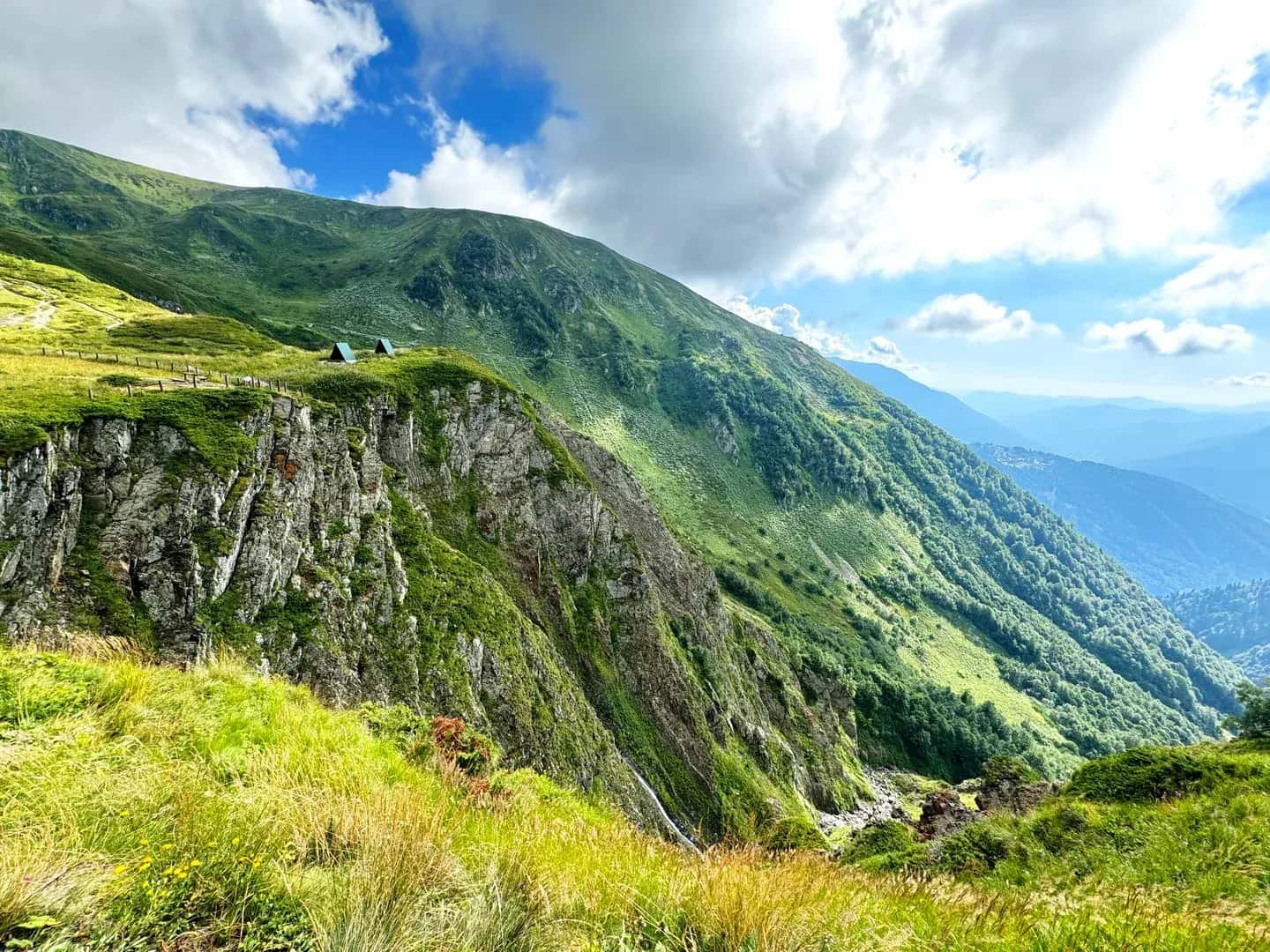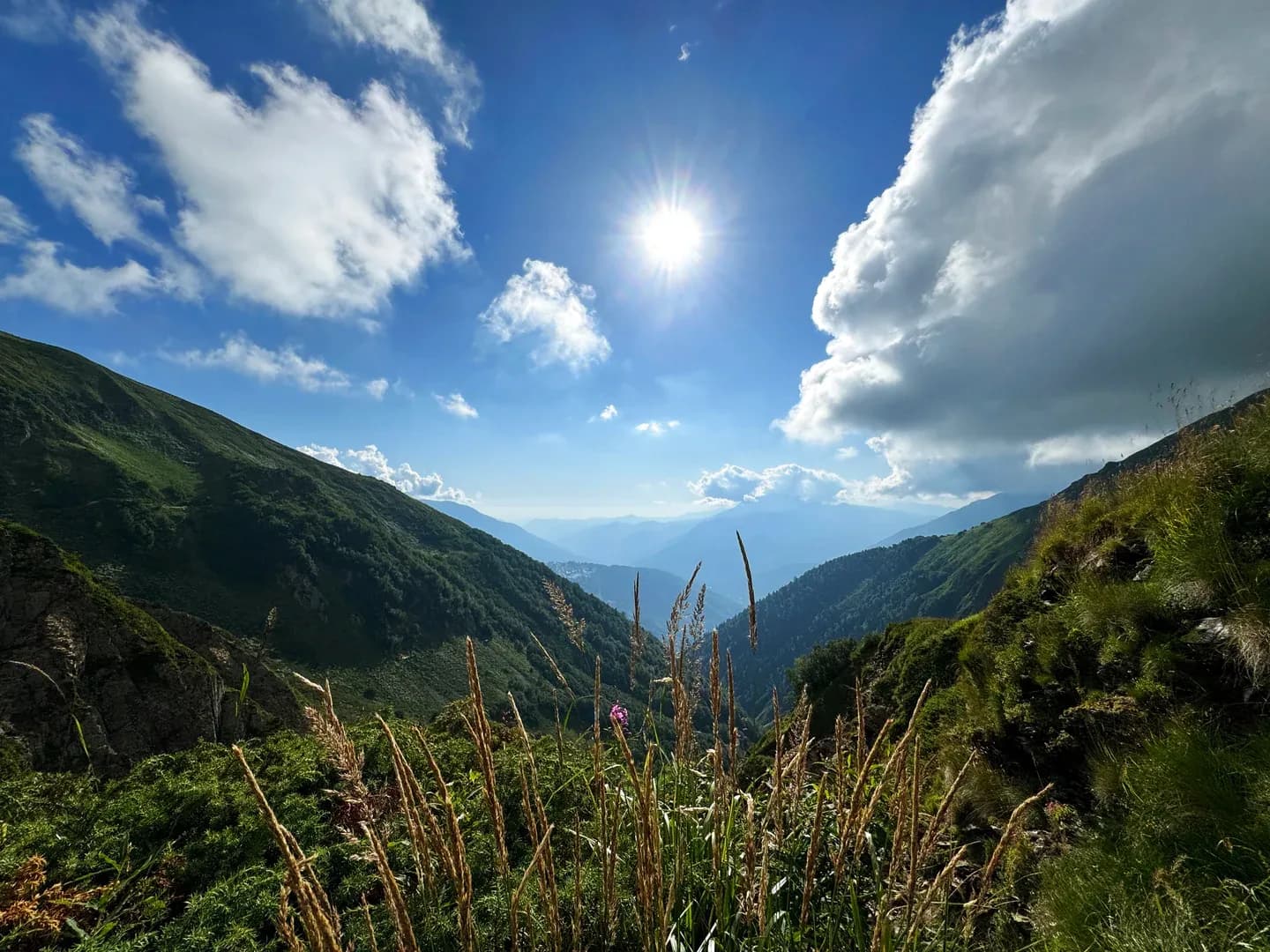
The trail to the cornice is not hard, and the whole "reward" is gathered at one point - the edge of the cliff. Here the slope drops away, nothing blocks the horizon, and the panorama opens at once across tens of kilometres. Let us take it direction by direction - what to look for, and where.
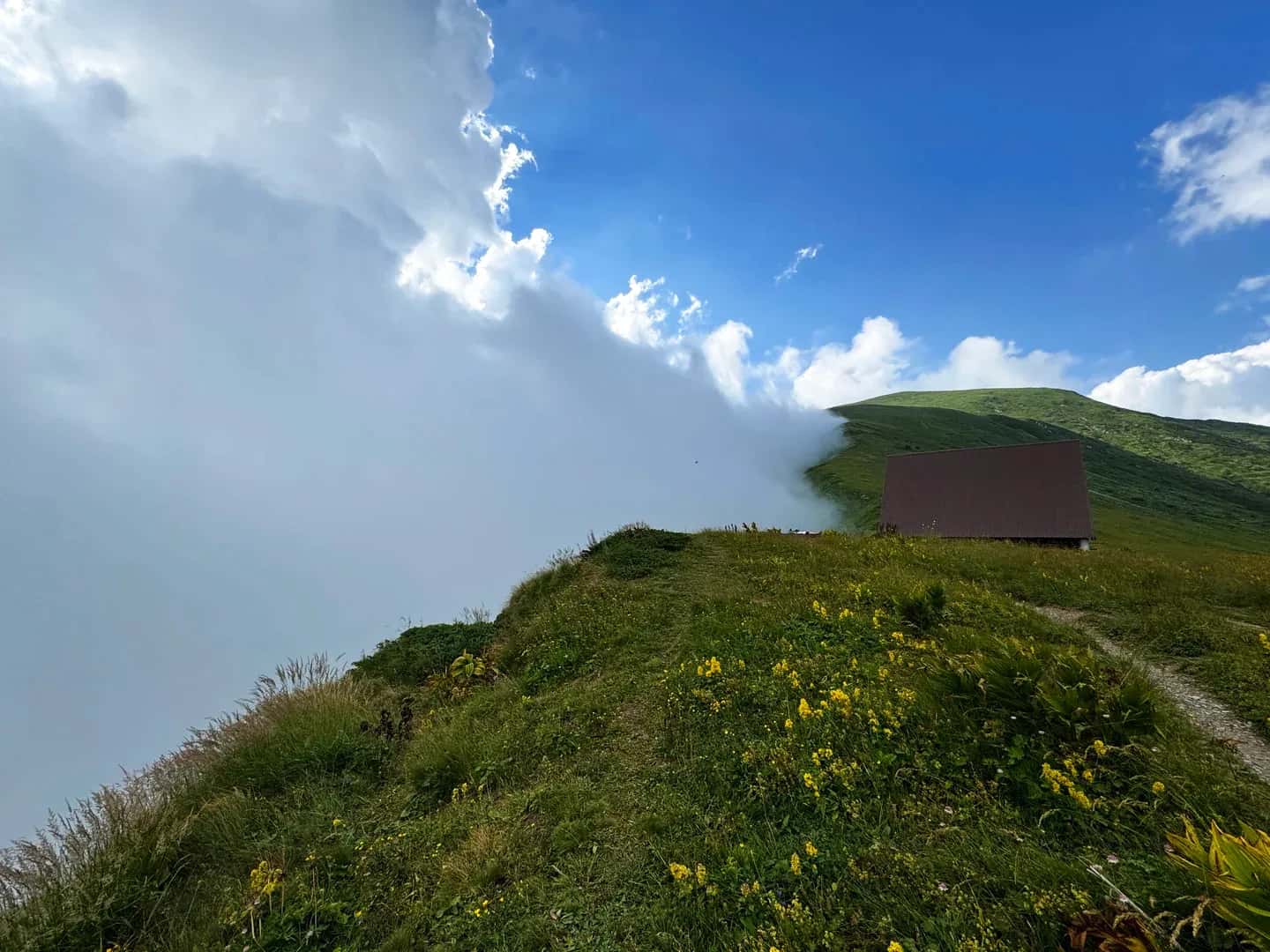
An important caveat: everything described below is visible in clear weather. In cloud or fog the panorama collapses to the nearest few metres - why this is so is explained in the article on the cornice microclimate.
To the south - the Aibga ridge
Directly opposite, across the valley of the Mzymta river, runs the Aibga ridge (its highest point about 2,513 m). This is the "mirror" side of the area: if the cornice stands on the northern wall of the valley, then Aibga is on the southern. On its slopes are the ski runs and cable cars of the Rosa Khutor and Alpika resorts.
The name itself, by one account, comes from the Abkhaz "abga" - "cliff". So from one cliff you may well be looking at another. More on the names is in the piece on the history and place names of the cornice.
To the east - the Main Caucasus Ridge
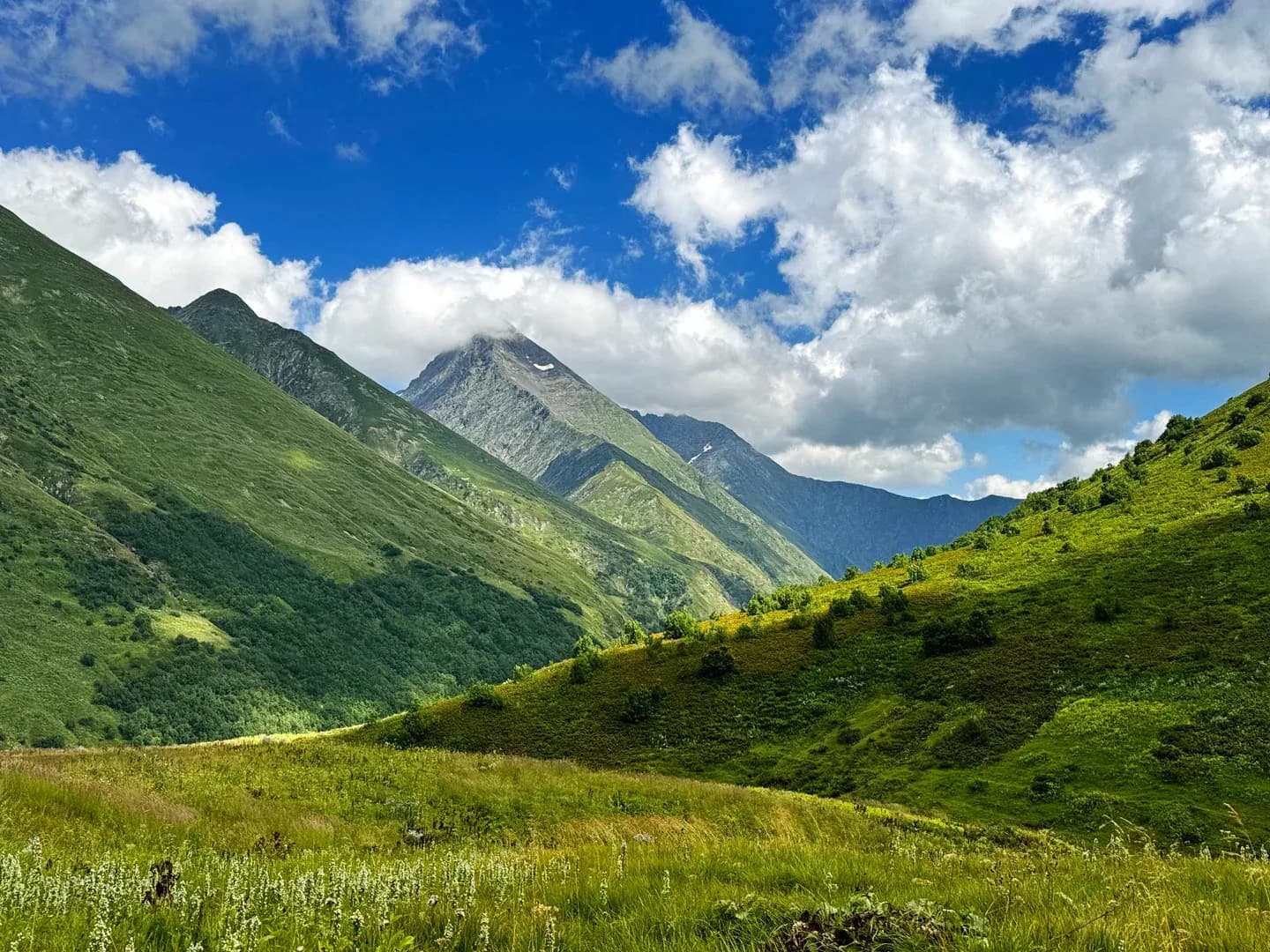
The most striking sight is to the east and south-east: the snowy peaks of the Main Caucasus Ridge. Closest and clearest is the Pseashkho massif, and above it Sakharnaya Pseashkha (3,188 m) with its pale, "sugar" snow cap, which is what gave the peak its name.
This is already the high, "real" Caucasus - elevations beyond three thousand metres, where snow and ice hold year-round. From here, at 2,063 m, they are far off, but in the clear air they seem deceptively close.
The "Sakharnaya" peak, in the Adyghe reading, is interpreted as "the mountain by the water": psy - water, uashkhe - mountain. The first written mention of the name Pseashkha is dated to 1864.
Quick quiz: the cornice panorama

Below - the Mzymta valley
Below the cliff, far down, lies the Mzymta valley - the very one you came up through. In good weather you can make out villages and resort buildings, the threads of the cable cars, and sometimes the glint of the river itself. The contrast is strongest in summer: down there subtropical greenery and warmth, and up here, at the edge, wind and near-freezing nights.
This "top-down" view is a living map of the area: you can see how the Mzymta divides the mountains into a southern (Aibga) and a northern (Psekhako, Bzerpi) side. What lies beyond the cornice, deeper into the reserve, is in the article on nearby places.
When the visibility is best
A panorama is a capricious thing. The best conditions:
Early morning. The air is clear, the distant ridges read sharply, and no cloud has yet built up on the crest. By midday the visibility, as a rule, drops.
September. In autumn the air is drier and cleaner than in summer - many reckon the September views from the cornice to be the farthest of the whole season. After rain and during an inversion (when the cloud stagnates below, in the valley) it can also be especially clear and far-reaching. The months in detail are in the article on the seasons on the cornice.
"The Bzerpinsky cornice is a natural viewing platform: from the cliff a panorama opens onto the Main Caucasus Ridge and the Mzymta valley."- site description, local-history sources
Where to look from
The best panorama is from the very edge of the cliff, but this is exactly where you need caution: the edge is unstable. You can take photos and enjoy the view a few metres back from the brink - the view loses nothing by it, and the risk vanishes. The rules for behaviour at the edge are in the article on trail hazards.
And a last piece of advice: don't hurry away. The light on the mountains changes every half hour - what looks like a grey wall in flat midday light turns, in the sun of sunset or sunrise, into the very picture that made the climb worth it.