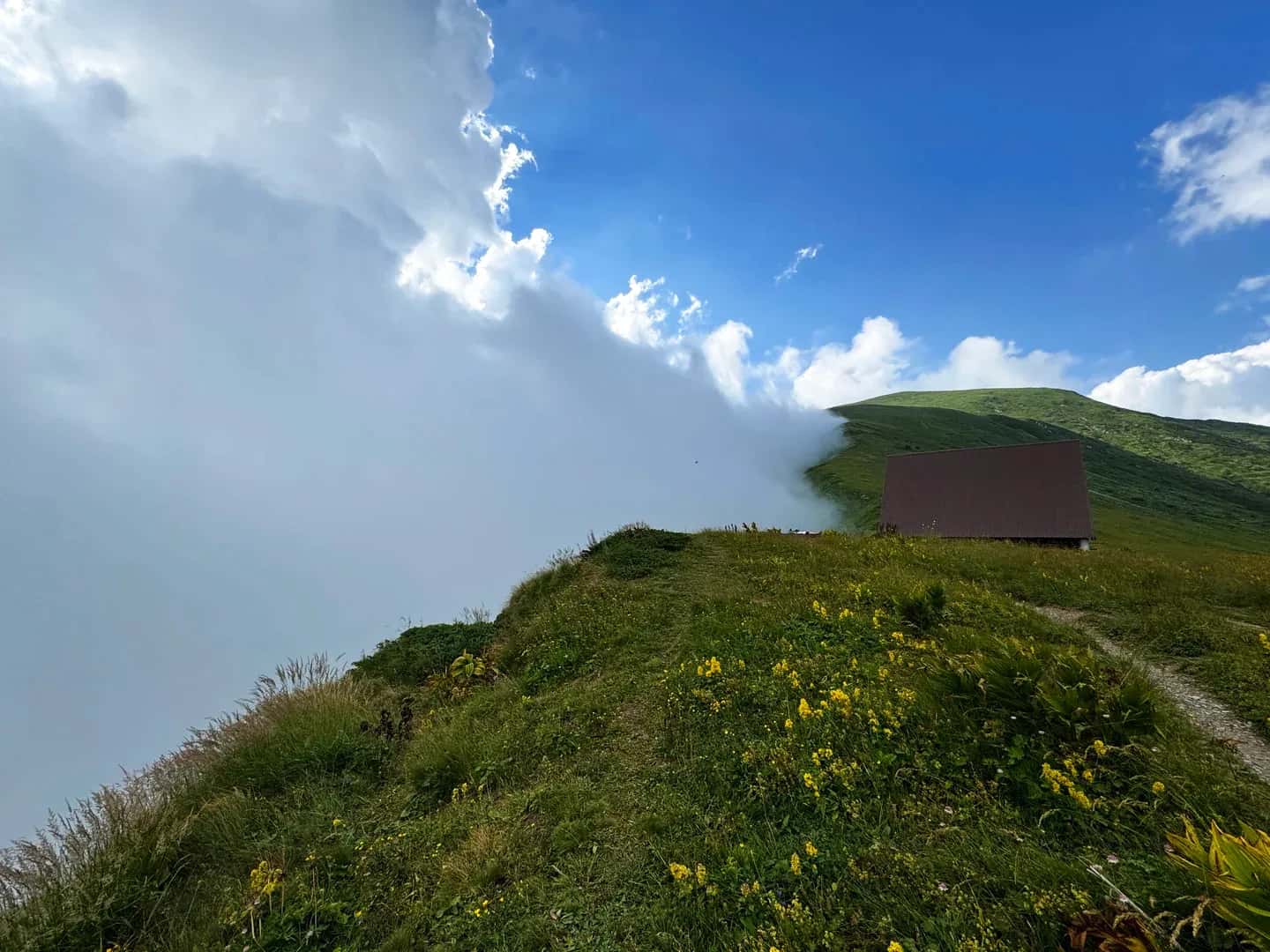
People often think of the Bzerpinsky cornice as an "easy stroll with a view". The trail really is undemanding, and therein lies the trap: complacency is the chief risk factor. The very word cornice means a cliff edge - a shelf of rock above a drop - and most of the dangers here come not from the difficulty of the route but from inattention.
Let's go through them in descending order of likelihood: what can really go wrong, and how to avoid it.
The main danger is the edge
The cornice is a cliff. The most common accidents at viewpoints like this, across the whole country, are falls from the rim, almost always for a photograph. The soil and turf right at the edge are undercut by wind and meltwater, held on by next to nothing, and give way under a person's weight - especially after rain.
Hence a simple rule that saves lives: don't go right up to the rim. A good shot works just as well a few metres back from the edge. Don't sit with your legs dangling, don't climb onto isolated rocks by the drop, don't pose with your back to the abyss.
Keep a distance from the rim at which a fall is simply impossible - on an unfamiliar edge that's easily 5–10 metres. No shot is worth testing how firmly the turf holds underfoot.
The weather turns within minutes
At around 2,063 m the weather lives a life of its own. A clear morning gives way by midday to a thunderstorm, and the cornice and the meadows around it are open ground, where a person becomes the highest point. In a storm you need to head down, not wait it out up top, and certainly not shelter under a lone tree.
The second common trouble is fog. A cloud settles on the ridge in a matter of minutes, visibility drops to a dozen metres, and then the nearness of the cliff turns from a "view" into a real threat. In fog - don't go near the edge, and stay on the trail. Why the weather here is so changeable is covered in detail in the article on the cornice microclimate and on the cornice weather page.
Quick quiz: safety on the cornice

Cold even in July
Down in Krasnaya Polyana it can be +25 °C, while on the cornice it's around +17 to +19 °C in shade (warmer in the sun); but a cloud or wind-driven rain rolls in and it drops fast. The chief risk of the warm season is hypothermia: a hiker sets out in a T-shirt, gets caught up top by rain and wind, gets soaked and cold. By October the cold is more serious: by day, in the sun, it can still be warm, but on average it's already around zero, and for an overnight you need a warm sleeping bag and a down jacket.
The three-layer principle works: base layer / T-shirt, fleece or a light down jacket, a wind- and waterproof shell. A rain shell or membrane is essential even with a perfect forecast - the mountains don't read forecasts. A hat and gloves won't go amiss in autumn.
With altitude the temperature drops by about 0.6 °C every 100 metres. From the lower cable-car station to the cornice the elevation gain is over a kilometre - that's "minus 6–7 °C" from altitude alone, before you count the wind.
Animals: bear, chamois, tur
These parts are home to the brown bear, the chamois, the West Caucasian tur and the wild boar. The hoofed animals avoid people on their own - to glimpse a tur or a chamois from afar is great luck, not a threat. The real rules concern the bear, and they are officially set out in the rules of Sochi National Park.
Prevention: don't walk alone, and walk "loudly" enough - talk, so the animal hears you in advance and moves off. On meeting one - don't panic, don't run (running triggers a chase), don't look it in the eye, step away calmly. And the key thing about any animal on the cornice, from a bear to a fox: don't feed it. A full account, with the reserve's rules, the places encounters happen and what is known about attacks, is in the article "Bears in Krasnaya Polyana and on the Bzerpinsky cornice".
"When you meet a brown bear, try not to panic… On no account run! Don't try to offer the bear a treat - by teaching it to beg, you are signing its death warrant."- from the rules of Sochi National Park, npsochi.ru
What to take with you
The minimum kit for a single-day outing to the cornice: 1.5–2 litres of water (springs are scarce up top), a snack, three layers of clothing + a rain shell, a hat and sun protection (it's easy to burn at altitude even under cloud), a charged phone and a power bank, a basic first-aid kit, and trekking boots with a grippy sole.
The signal on the route is unreliable - you can't count on your phone as a guarantee of help. The single emergency number is 112: it works even when your own carrier has no coverage and with no credit. Before you set off, it's worth telling someone your route and your expected return time.
When to turn back
The most grown-up decision on the route is to turn back before reaching your goal. Turn back if: a storm is building; fog has come down and visibility is gone; you're falling behind schedule and risk missing the cable car down (Alpika until 17:30, backup via Gazprom Laura until 19:00); someone in the group is exhausted or chilled.
The cornice has stood here for thousands of years and will wait until next time. Count your time backwards from the cable car: when is the last ride down - minus the descent - minus a margin for the unexpected. If by that reckoning time is tight, it's better to turn back early. All the rules for entering the reserve, without which you won't even reach the trail, are gathered in the article on the reserve's rules.