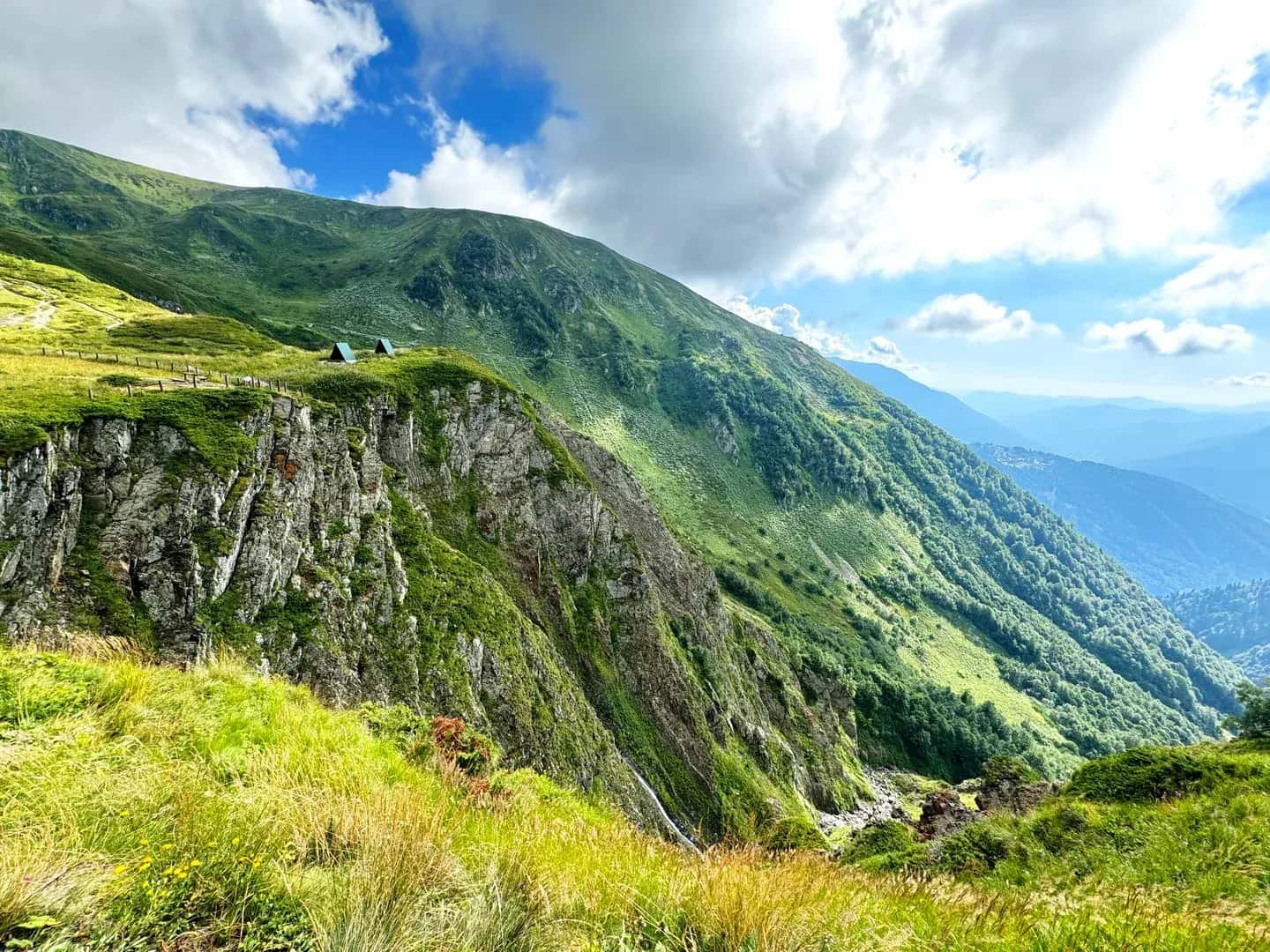
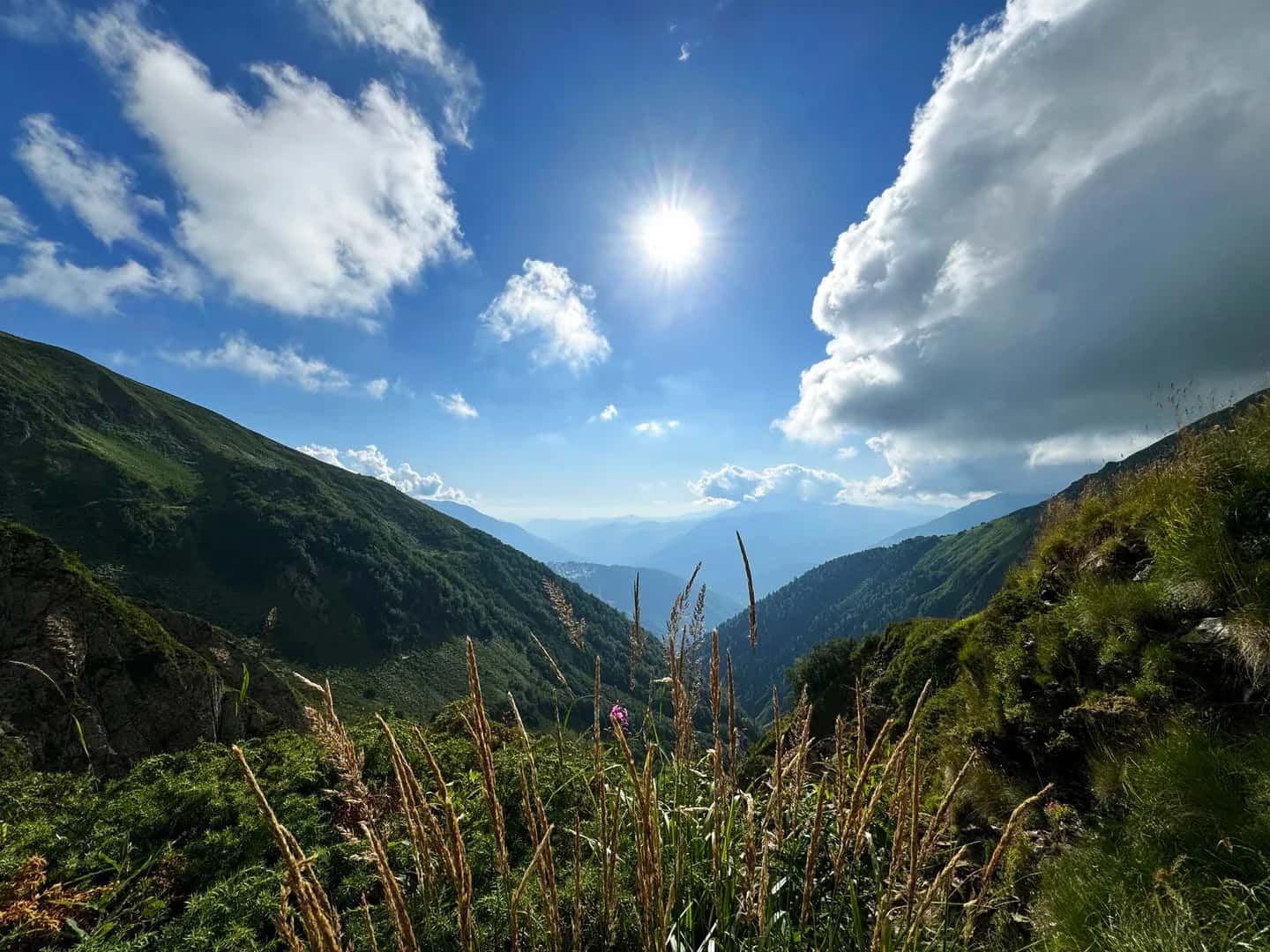
Most hikers reach the cornice, take in the panorama and turn back - and that's a normal, complete single-day route. But it's worth knowing: the official route No. 8A doesn't end at the cornice. It carries on, deeper into the reserve, to Kholodny Camp. And along the way are several places people come back for, this time with an overnight.
An important caveat up front: everything beyond the cornice is a multi-day format (1–3 days), not a "dash there and back". And remember that the reserve permit is counted by the day - the details are in the article on the reserve's rules.
Bzerpi Peak
The nearest true summit is Bzerpi Peak, 2,482 m, by Mount Tabunnaya. The very peak that the local historian Yuri Yefremov named in the 1930s (more on that in the article on history and place names). It opens up an even wider outlook than the cornice itself - but this is already a climb to a summit, not a stroll across the plateau.
The Pseashkho pass and the obelisk
Further on the route leads out to the Pseashkho pass (2,014 m). Here, between the pass and Kholodny Camp, stands an Obelisk of Glory - in 1942–1943 the Battle of the Caucasus ran through these passes, and soldiers of the 20th Mountain Rifle Division stopped the "Edelweiss" units from getting through. We cover that history separately; here, just know that the way to the lakes passes the obelisk.
The Pseashkho pass is already a watershed: from it the trail descends to the northern, "trans-Kuban" slope of the Caucasus, along the right bank of the Urushten river. You literally cross from one side of the Main Range to the other.
The Dzitaku lakes and Maloye Lake
The chief "jewel" of the surroundings is the Dzitaku lakes, of which there are seven, hence the popular name "the Seven Lakes". They lie a few kilometres north of the Pseashkho pass, at the foot of Mount Dzitaku, in basins of glacial origin - the very traces of ancient glaciation discussed in the article on how the cornice is formed.
One of them - Maloye Lake - lies right by the Pseashkho pass, and it's the one people most often make a side trip to. The water in such lakes is cold and clear, and in early summer snowfields still linger along their shores.
Quick quiz: what's near the cornice

Kholodny Camp
The end point of route No. 8A is Kholodny Camp (1,770 m), by the Urushten river, near the bridge over the Kholodnaya. It's a fitted campsite for multi-day trips: from here people make side trips to the Dzitaku lakes and towards the glacier. From the cornice to the camp is about 7.5 km, with a descent of roughly 350 metres.
As everywhere in the reserve, you may stay overnight only at fitted campsites - pitching a "wild" camp is forbidden. Which brings us back to the rules: the regime applies along the whole length of the route, not just at the cornice.
How it all connects
To put the picture together: the cornice is the threshold of a great protected world. Beyond it are summits, passes, glacial lakes and the memory of war, all strung along a single trail running the length of the Main Caucasus Range. A single-day outing to the cornice shows only the "hallway"; everything else opens up to those ready for an overnight.
"The Dzitaku lake valley lies a few kilometres north of the Pseashkho pass; the Dzitaku lakes are seven lakes of glacial origin at the foot of Mount Dzitaku."- from local-history descriptions of the route
And once more about that important divide: we tell you what is around and how it's arranged. For specific programmes, overnights and a guided escort, turn to the tour operators - that's their part. And the easiest way to begin getting to know the place is with the root article on the cornice.