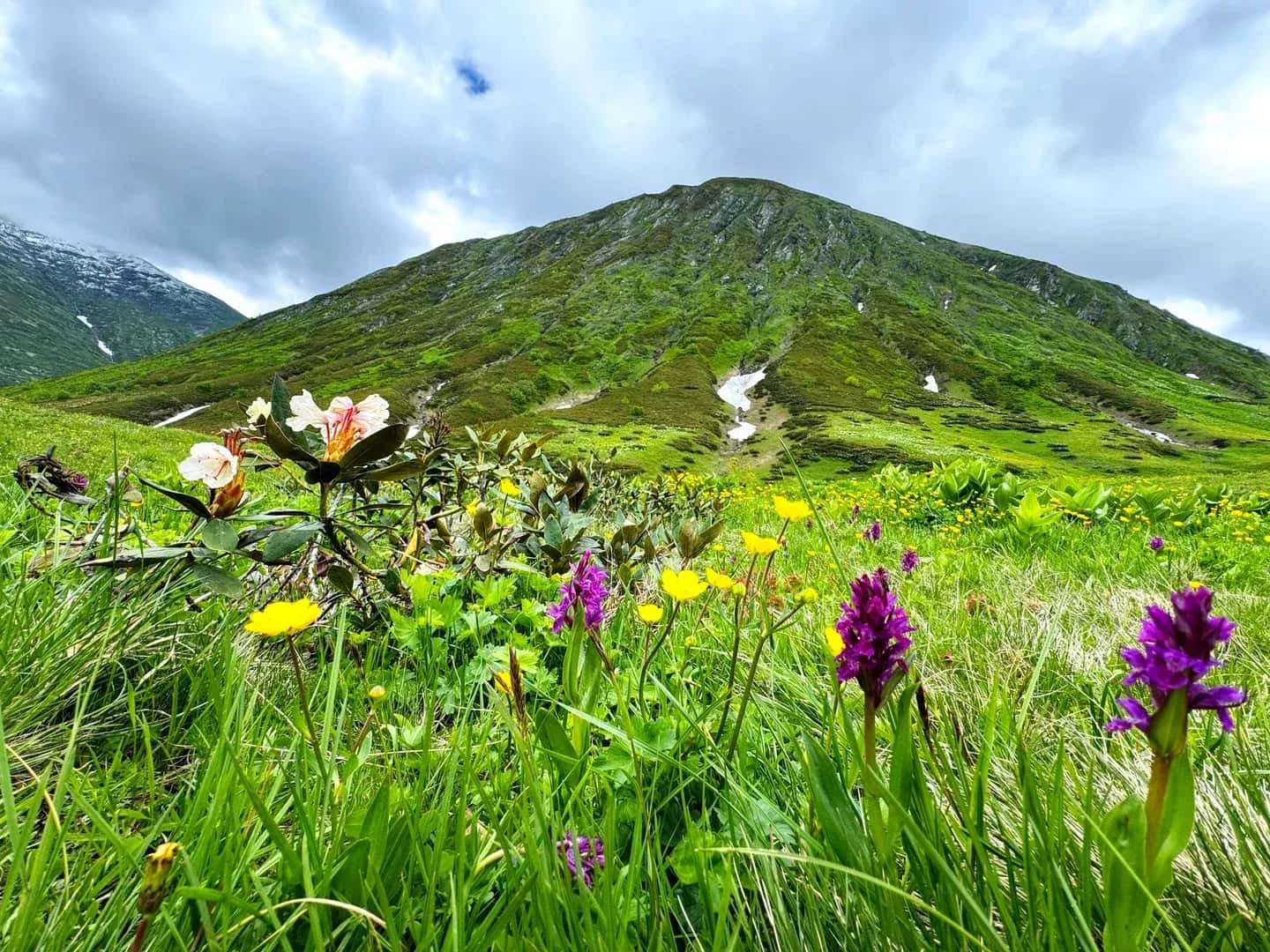
The Bzerpinsky cornice is a cliff at 2,063 m, and it sits right on the line where the krummholz gives out and the open meadows begin. Summer here is short, vivid and tightly packed: the snow melts late and the first frosts come early, so the plants are given just a few months to do everything - to grow, to flower and to set seed.
But in those months the meadow manages to change outfits several times over. The Caucasus Reserve describes it as a succession of vivid aspects from dozens of flowering plants - as one species fades, another takes its place, and the slope literally changes colour before your eyes, until the autumn frosts paint everything ochre.
Three belts and one cliff
By elevation, the reserve’s vegetation is divided into belts. The subalpine belt runs from 1,800 to 2,400 m, the alpine belt from 2,200 to 2,900 m, and above 3,000 m the subnival belt begins, with sparse cushions of plants among the rocks. The cornice, at 2,063 m, is subalpine: tall-herb stands, rhododendron thickets and mixed-herb meadows.
Along the lower edge of the subalpine belt (roughly 1,600–2,000 m) grows the famous Caucasian tall-herb vegetation. Hogweed stems here rise to 3.5–5 metres on stalks 8–10 cm thick - in such a stand a grown adult disappears from head to foot.
June: the rhododendrons open the season
The first great “aspect” of summer is the rhododendrons. The reserve has four species, but two catch the eye around the cornice: the yellow one (azalea, Rhododendron luteum) flowers in late May and early June along the forest edge, while the white Caucasian rhododendron (R. caucasicum) - an evergreen endemic - opens from mid-June higher up the slope, right after the snow melts.
Exact timings by species, the elevations and where to look for them are in a separate article, “When the rhododendrons bloom on the Bzerpinsky cornice.”
“On the subalpine meadows along the forest edge you can often see three rhododendron species flowering at once - the yellow, the white and the pink.”- Caucasus Nature Biosphere Reserve
July: tall-herb stands at full height
By July the meadow enters its most exuberant phase. The subalpine tall-herb stands are led by the umbellifers and the daisy family: hogweeds, the milky bellflower (Campanula lactiflora) with its clouds of pale-blue flowers, ragworts (Senecio) and the handsome yellow oxeye (Telekia speciosa) with its large yellow “daisies.”
This is the very moment when photographs of the cornice look like postcards: waist-high wildflowers, the cliff above them, and beyond the cliff the valley opening out. But the “postcard” view does not last long - within a couple of weeks the aspect shifts again.
Endemics: what grows only here
The chief botanical feature of these slopes is its endemics - plants found only in the Caucasus and nowhere else on Earth. In the reserve’s flora their share reaches 35 %: roughly one plant in five is an endemic or a relict. Of its 454 endemic vascular-plant species, about 60 % occur in the high country.
Among the high-mountain endemics are the Oshten bellflower (Campanula ossetica), Helena’s buttercup (Ranunculus helenae) and the Oshten skullcap (Scutellaria ossetica). They are easy to walk straight past: not showy tall herbs but small plants pressed close to the ground, growing on rock and scree.
Quick quiz: the cornice meadows

August–October: colchicum and gentians
As autumn nears, the meadow pales but does not empty. From the second half of August through October the subalpine meadows fill with colchicum (Colchicum) - lilac and purple-violet goblet-shaped flowers that push straight out of the ground, without leaves. Beside them the gentians (Gentiana) turn blue and violet, crocuses glow like little orange flames, and between them are scattered the white “stars” of sandwort.
This is the season’s last aspect. After it come the first frosts - and within a few days the slopes trade their greens and lilac-blues for unbroken ochre. The meadow falls asleep until the following June.
How to look without doing harm
The main rule is simple: look and photograph, do not pick. Many of the plants here are endemics and Red Data Book species, and in the high country they already have little time and little strength to spare. A picked bouquet here is not “a few flowers” - it is the torn-out seed of next year’s meadow.
Stay on the trail: turf trampled off-trail at this elevation takes years to recover. And remember the reserve’s rules - no pets are allowed, and not only for the animals’ sake: a dog easily tramples and eats rare plants.
The earliest flower of these slopes is the Caucasian snowdrop (Galanthus), listed in the Red Data Book. You won’t catch it at the cornice: it flowers while the snow still lies, long before the season opens. More on protected species in a separate article.