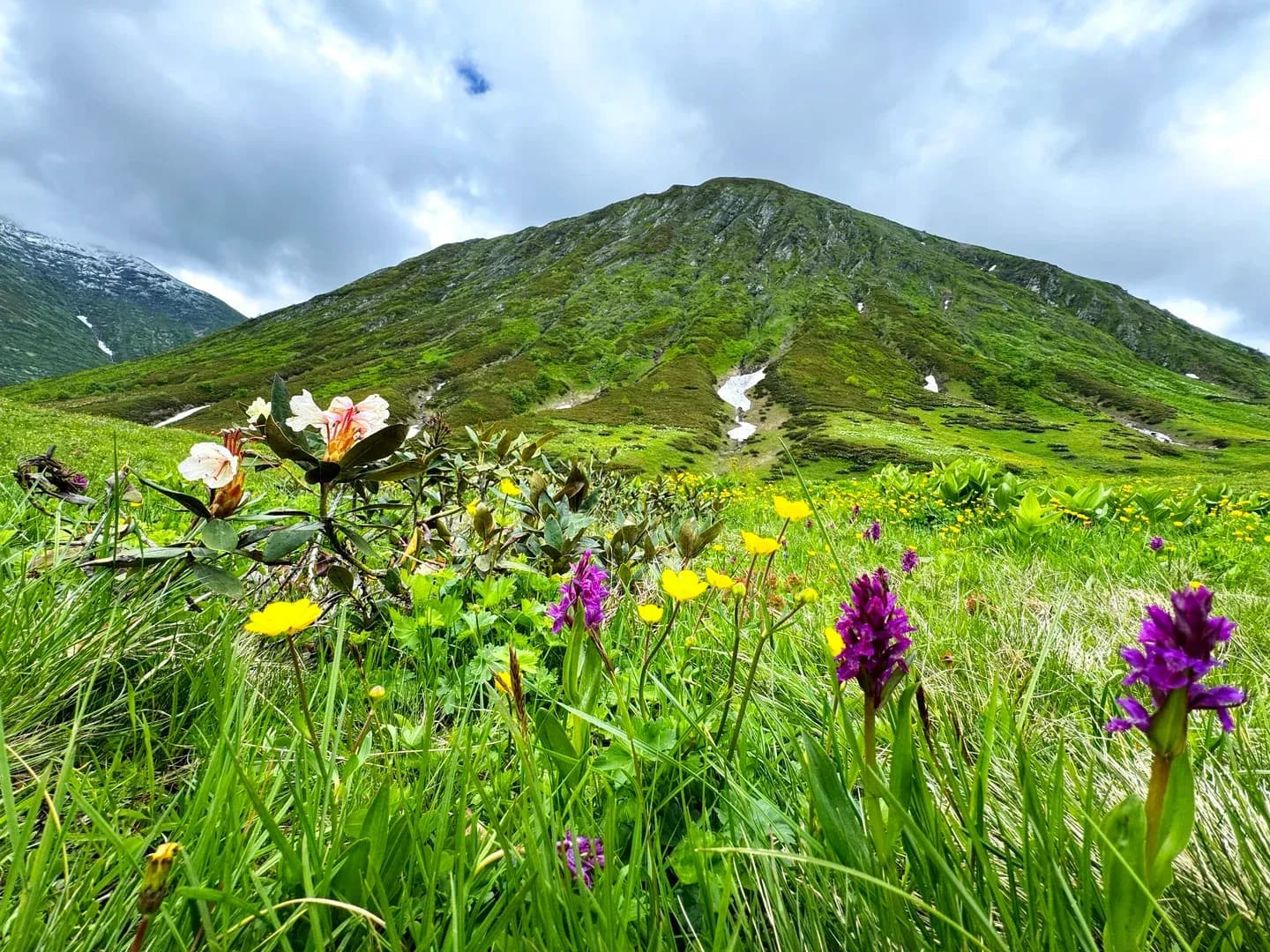
The rhododendrons are the main flowering event of the Bzerpinsky cornice. In short: the yellow one (azalea) flowers in late May and early June, while the white Caucasian one opens from mid-June and lasts into July. By the cornice (a cliff at 2,063 m) you can catch both - the yellow along the lower forest edge, the white higher up the slope.
The Caucasus Reserve has four rhododendron species in all - the yellow, the white Caucasian, the Pontic (lilac) and the Sochadze hybrid (pink). But by the cornice it is two that catch the eye: the yellow and the white.
The yellow rhododendron (azalea)
The yellow rhododendron (Rhododendron luteum), also known as the azalea, is a deciduous shrub with bright, fragrant flowers. It blooms first: in May in the lower-mountain band, and in the first ten days of June it climbs higher, to the upper forest edge (around 2,000 m). The flowering is short - only 2–3 weeks.
The white rhododendron (the Caucasian)
The Caucasian rhododendron (Rhododendron caucasicum) is an evergreen shrub and an endemic: it grows only in the high country of the Caucasus and Turkey. The flowers are white and cream, with faint pinkish and yellowish tints and speckles inside. On the cornice it opens from mid-June, right after the snow melts, and at different elevations it flowers all the way into July and August - the higher the slope, the later it comes.
The Caucasian rhododendron keeps its leaves through winter and is hardy against frost: the down on its leaves shields it from wind, temperature swings and ultraviolet light, while its powerful roots hold the slope against erosion. That is why it climbs higher than the rest.
Where to look by the cornice
Look for the yellow azalea lower down, along the forest edge and on scree slopes up to about 2,000 m. The white Caucasian is higher - right on the subalpine meadows by the cliff itself: it forms dense, low-creeping thickets that in June drape the slope in a white “blanket.”
Quick quiz: rhododendrons

How to photograph without doing harm
The rule is simple: look and photograph, do not pick. Every rhododendron species is poisonous, so there is no reason to touch them, let alone taste them. Besides, the cornice is reserve land, where any plant is there to be observed, nothing more. Stay on the trail, do not trample the thickets - and do not come with pets: the rules forbid it.
If you want more on what else blooms by the cornice from June to October - from the tall-herb stands to the autumn colchicum - read the article on the flora of the subalpine meadows.