The Caucasus Nature Biosphere Reserve holds 89 species of mammal and more than 250 species of bird. But at the elevation of the Bzerpinsky cornice, in the subalpine zone and above, only some of them live: those that have adapted to the short summer, the rock and the cold nights. This guide is about the ones you can actually meet by the cliff.
One caveat up front: to “meet” is not to “approach.” Everything below is about watching from a distance. The rules for encounters are gathered at the end, and the fox, seen more often than any of them, has an article of its own.
The tur - master of the rocks
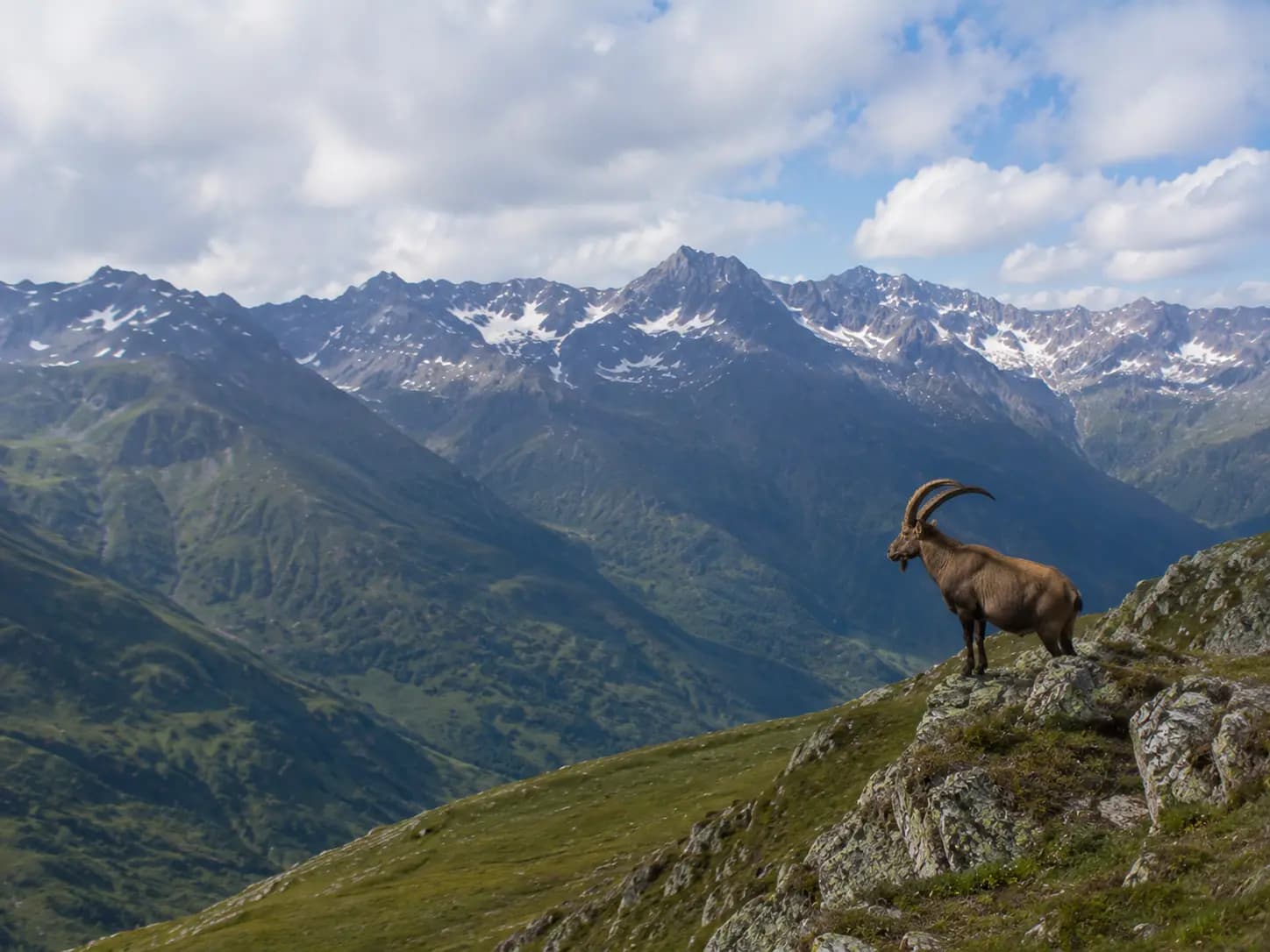
The signature animal of these heights is the West Caucasian tur (Capra caucasica), a wild goat and an endemic of the Caucasus: in all the world it lives only here, in the North-West Caucasus, and nowhere else. A large male reaches 150–165 cm in length and 65–100 kg in weight, with curved horns up to 75 cm long; you can read its age from the segments on the horns, like rings on a tree.
The tur keeps to 1,900 m and above, up to the very peaks, and favours rocky cliffs with ledges and niches - there it retreats from predators and from foul weather. In the reserve it eats no fewer than 195 plant species: in summer its diet is 80–90 % grasses, plus bellflowers, oxeye daisies, speedwell and gentians; in winter, dry grasses, shrub twigs, mosses and lichens.
The tur does not roam far. It makes no seasonal migrations of tens or hundreds of kilometres, as lowland animals do: it merely shifts a few kilometres up and down within a single ridge - following the snow and the grass.
“Tur quickly grow used to a steady human presence and often approach hikers’ camps.”- Caucasus Nature Biosphere Reserve
The chamois and the red deer
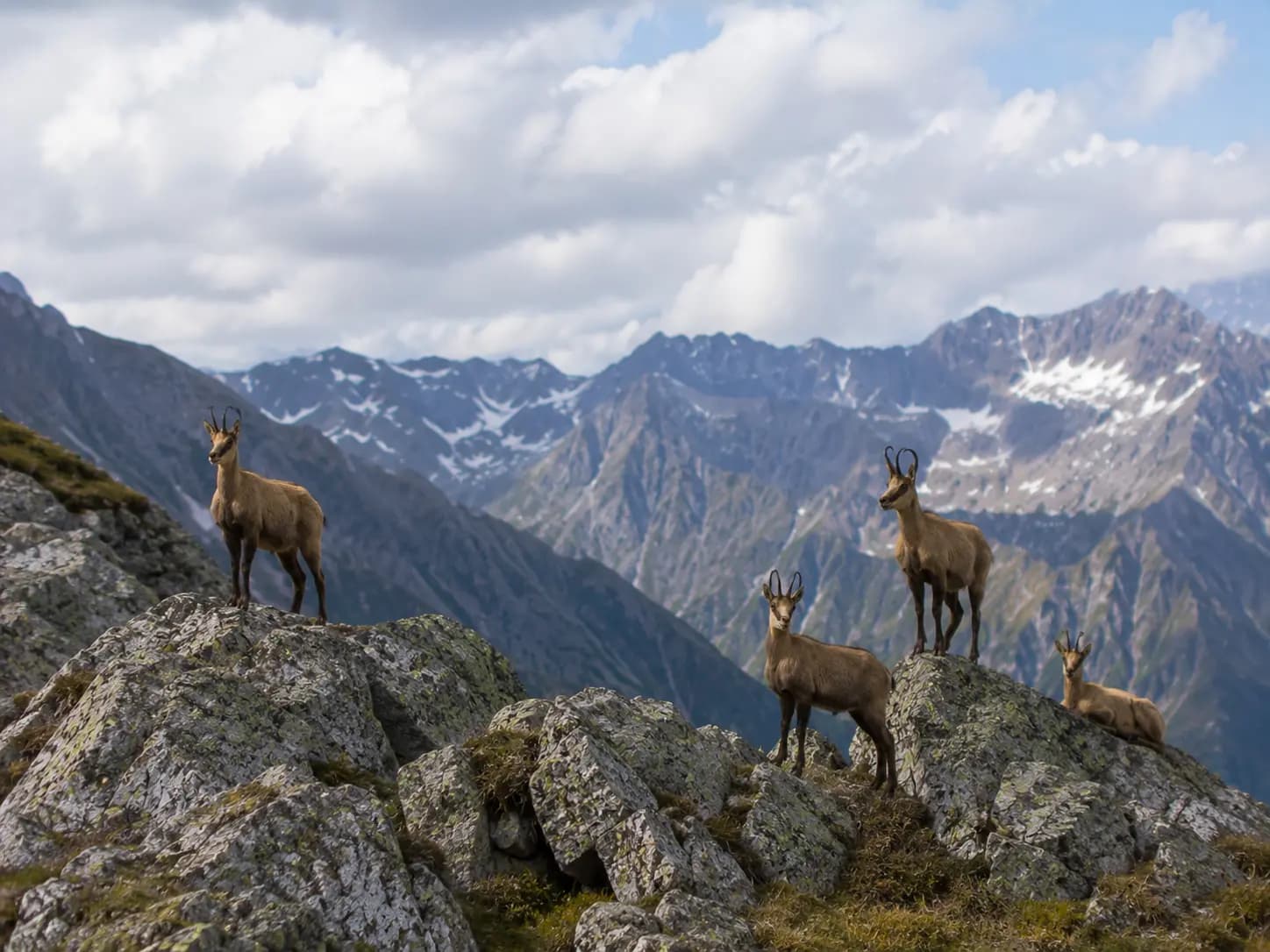
The Caucasian chamois (Rupicapra rupicapra caucasica) is the second hoofed resident of the heights. Smaller and lighter than the tur, it keeps to the seam between forest and meadow, and at any danger it retreats into the rocks: crevices and stone ledges are its chief refuge from predators and weather. The chamois is astonishingly sure-footed on steep ground - where a person moves roped and braced, it walks at an easy pace.
The Caucasian red deer (Cervus elaphus maral) climbs to the meadows in summer, but its great season is autumn. From September to the end of October comes the rut: the bellowing of the stags carries more than a kilometre, dominant bulls gather harems and drive off the young. To hear the autumn roar of a stag at the cornice is an experience in itself.
The bear: context, not a scare story
The Caucasian brown bear (Ursus arctos meridionalis) forms a single polymorphic population - the animals vary widely in size and colour. The reserve holds 300–400 of them (up to 400), one of the largest groupings in the Caucasus. The bear is here, and you should behave accordingly, but as a rule the animal avoids meeting people of its own accord.
In recent years, however, bears have been coming out to people more often. The resorts and villages of Krasnaya Polyana stand right against the reserve, frequently on old animal trails. Bears grow used to easy food: there are known cases of a she-bear with cubs feeding at a village rubbish dump, and of bears seen beneath the cable cars, watching the tourists. The cause is almost always the same - available food and rubbish. So the main rule is simple: leave nothing behind. For safety in detail, see the article on trail hazards.
Wakes: 5–10 March (females with cubs later, in April). Dens up: in December, en masse by mid-month. Eats: in summer mostly greenery and grasses on the meadows; in autumn it fattens on berries, and lower down on beechnuts, acorns and chestnuts. Cubs are born in winter in the den and weigh only about half a kilogram at birth; a litter comes once every two years.
Fox, marten, lynx, wolf
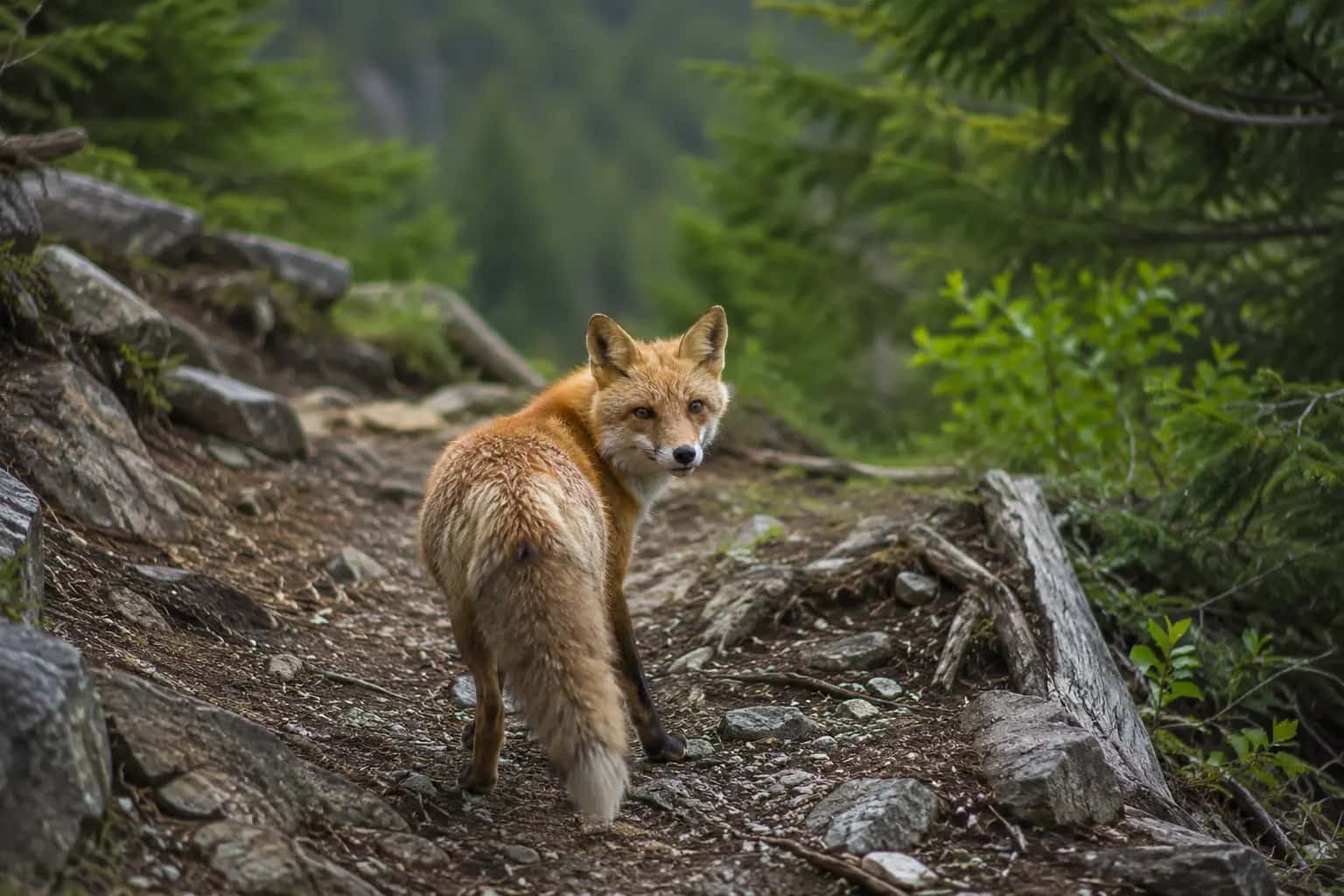
Of the predators, the one you meet most often by the cornice is the fox (Vulpes vulpes caucasica) - so often that we have given it a whole article. Living alongside, more rarely and almost always unseen, are the pine marten (Martes martes), the Caucasian lynx (Lynx lynx dinniki) and the wolf (Canis lupus cubanensis).
The lynx and the wolf avoid people, and to see one is a rare stroke of luck; the marten is active mostly at night. If something rustles in the grass at dawn, it is most likely not a fox but a marten returning from a night’s hunt.
Quick quiz: animals of the high country

Birds of the heights: eagles, vultures, grouse
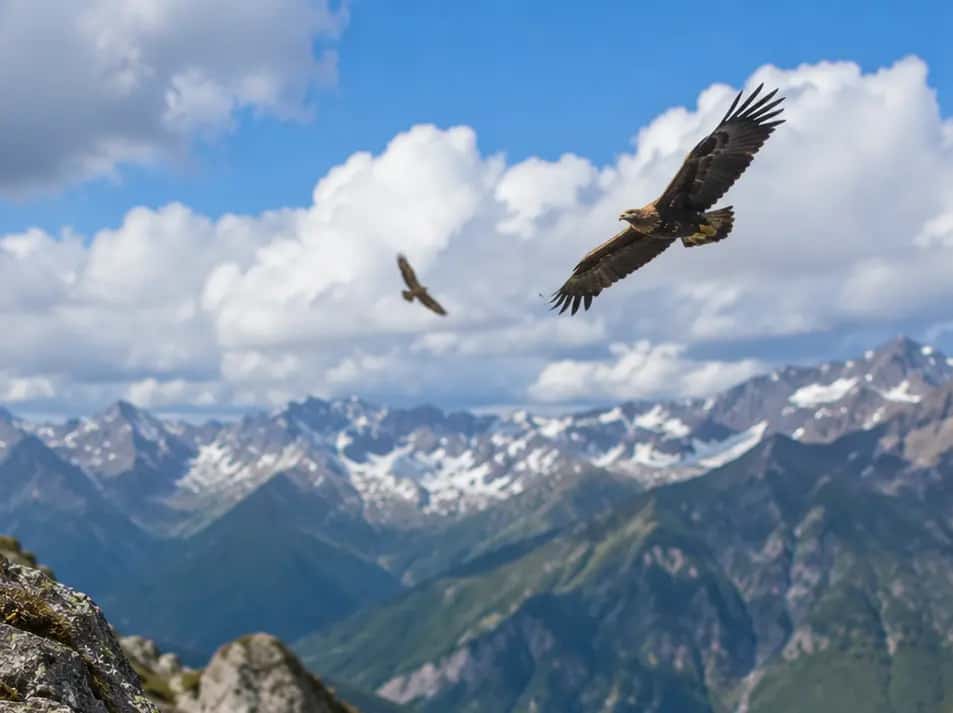
The sky above the cornice is a world of its own. Nesting here are the golden eagle (Aquila chrysaetos) - the reserve has several known nests and about four breeding territories - and the bearded vulture, or lammergeier (Gypaetus barbatus), whose wingspan reaches 2.7 metres. Both are listed in the Red Data Book of Russia.
On the meadows and in the rhododendron thickets lives the Caucasian grouse (Lyrurus mlokosiewiczi) - an endemic of the Caucasus and northeastern Turkey, and likewise a Red Data Book species. Higher still, among the rocks, keep the Caucasian snowcock, the alpine chough, the wallcreeper and the great rosefinch - typical birds of the alpine belt. Which of them are under special protection we cover in the article on protected species.
Rules for encounters
They are the same for every animal. Do not feed them - not the tur, not the fox: feeding breaks their behaviour and makes them dependent on people. Do not approach or corner an animal for a shot. Do not run when you meet a large animal - calmly open up the distance without turning your back.
And remember the reserve’s rules: no pets are allowed. A dog frightens wild animals and is itself at risk - an encounter with a bear or a jackal is dangerous for it. The full list of rules is in a separate article.
In autumn the alpine birds begin to gather into flocks and drift down into the valleys, while the squirrels busily “shell” the seeds from spruce and fir cones. This is how the high country readies itself for winter - and the best time to hear the roar of a stag and watch the meadows empty out.