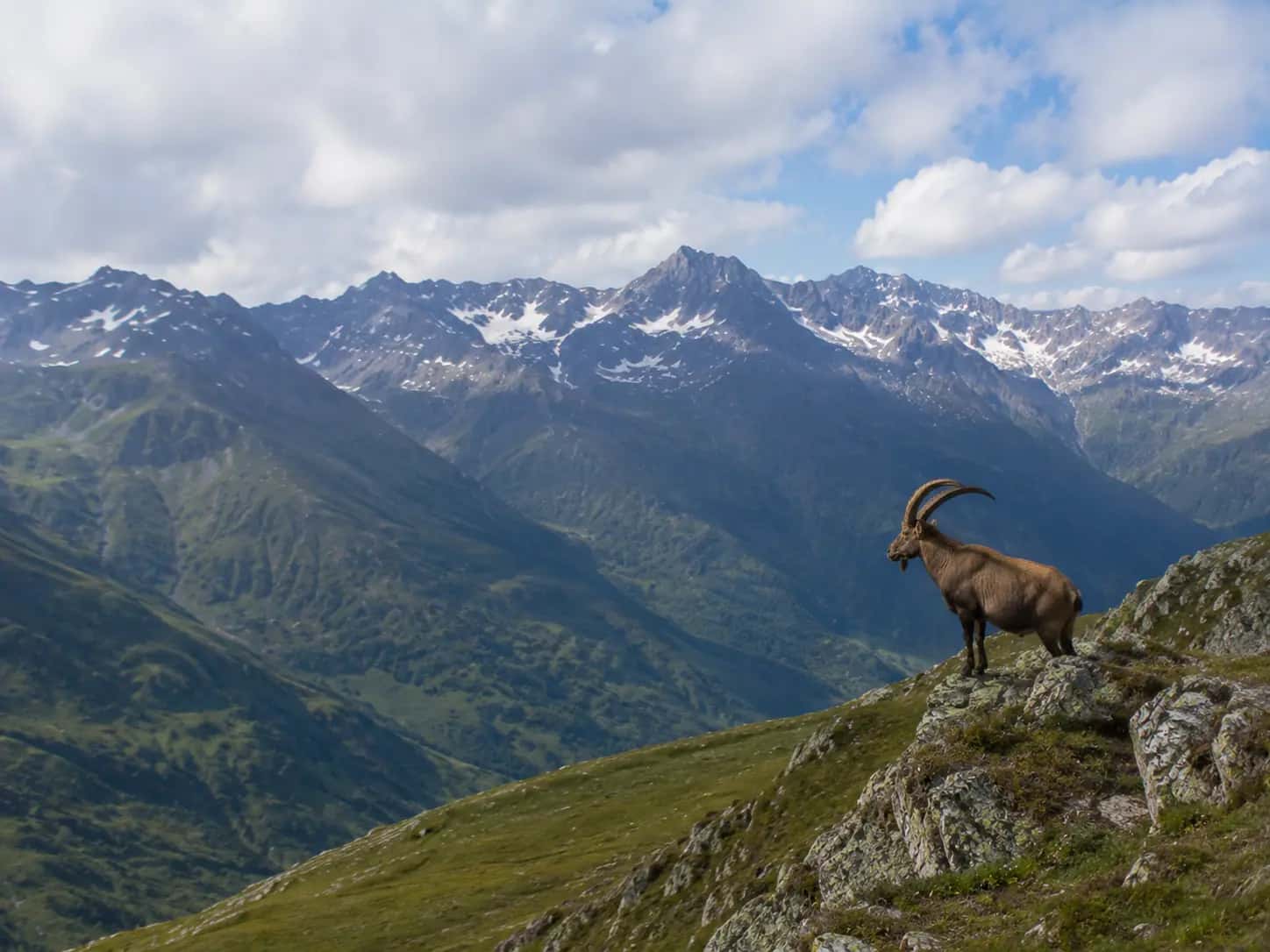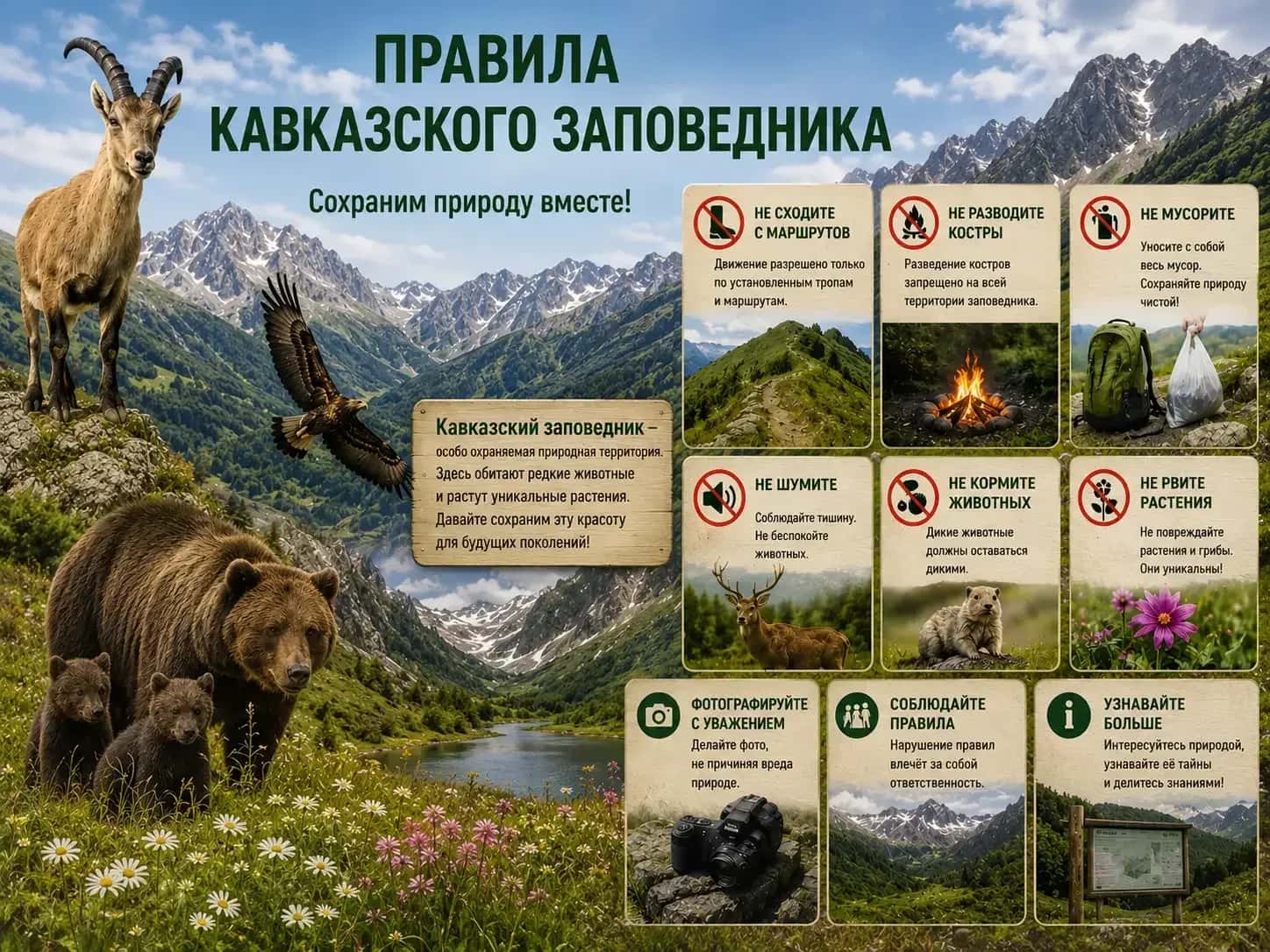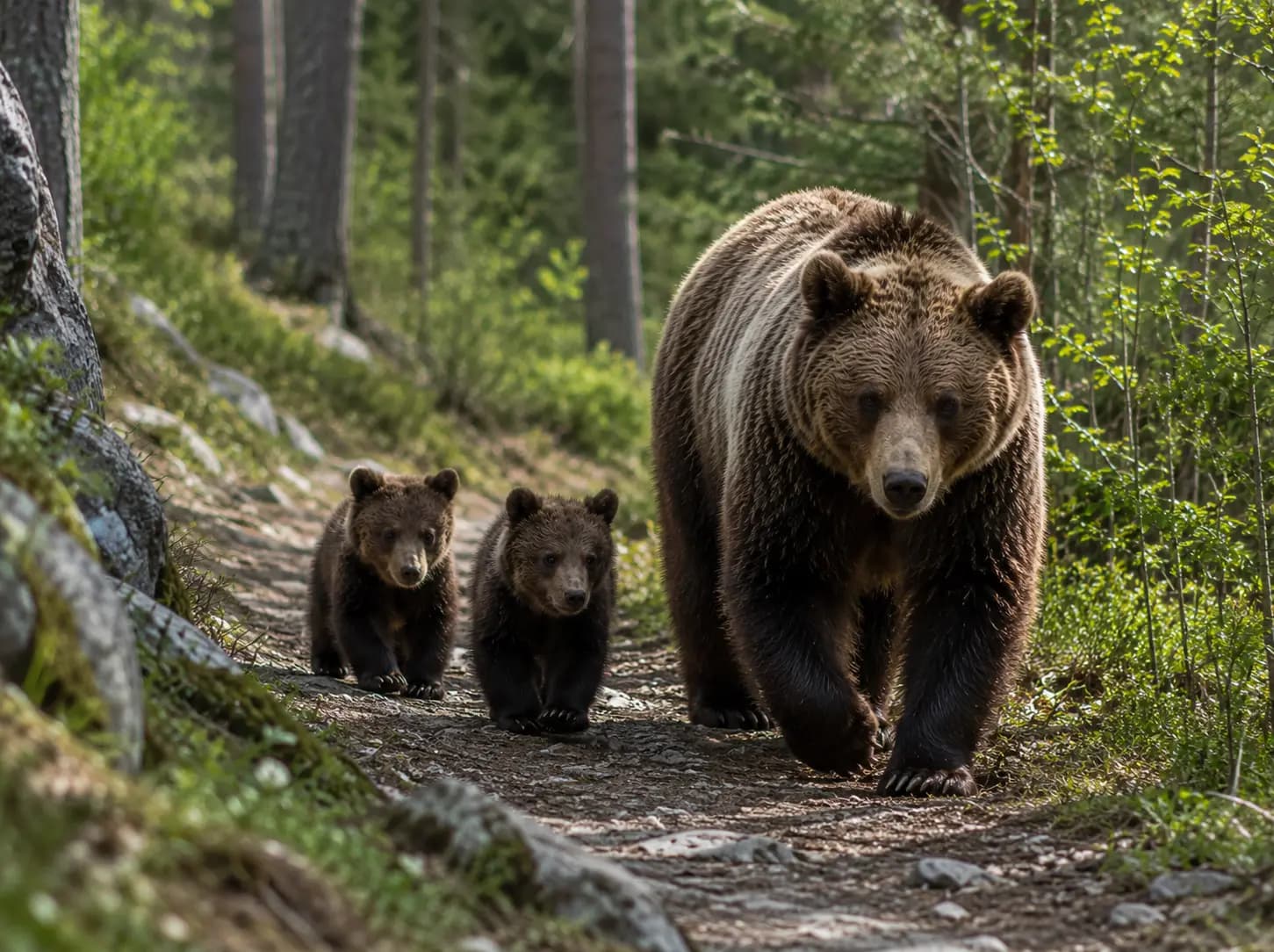
First, the main point: the Caucasus Nature Reserve has recorded no unprovoked attack by a bear on a human. The bear by the Bzerpinsky cornice is no horror-film menace but the master of these parts, one that as a rule keeps clear of people of its own accord. Even so, it is a large wild animal, and you need to behave correctly around it.
Are there bears in Krasnaya Polyana?
There are, and quite a few. The reserve is home to 300–400 brown bears, one of the largest populations in the Caucasus, and its boundary runs right up against the villages and resorts of Krasnaya Polyana, so a bear here is a neighbour rather than an exotic sight. This is the Caucasian subspecies (Ursus arctos meridionalis), with highly variable size and colouring: an adult usually weighs 150–300 kg, large males up to 400.
The zoologist Anatoly Kudaktin, whom the reserve cites, calls the Caucasian bears a distinct polymorphic group, matched only by the bears of the Tian Shan. Animals living on the same ground differ noticeably from one another, mostly in colour. That is why eyewitness accounts diverge so widely, although the species is one and the same throughout, the brown bear.
Where bears turn up most often
There are three such places, and they should not be conflated. In the villages the animal shows up because of food. Sochi National Park puts these visits down to a shortage of forage in the forest in summer and early autumn, exactly when the orchards ripen in bulk. Bears get into vegetable plots, rummage through bins and sometimes go for livestock.
At the Laura cordon the story is older than the resorts. Ancient Circassian orchards survive in Krasnaya Polyana, and the reserve's cordon stands on one of them. Wild pear, in Kudaktin's words, is the bear's first fattening food, so the animals come back to those old but fruitful trees year after year. In September 2021 guests at the cordon filmed a female with cubs calmly eating the fruit there: the animals were busy with the pears, and everyone went their own way in peace.
At mountain campsites it is a different matter. The reserve puts it this way: at tourist campsites the bear has long been the rightful master, and it is the tourists who come into its home. The cornice and the trail to it get their own section below.
One thing about the geography, because it gets muddled constantly. The village lies some 15 kilometres from the Bzerpinsky cornice and no trail connects them: you go up by the Alpika cable car to the Pikhtovy shelter, then on foot through the Bear Gates. The bear that has taken to the bins down below and the bear seen on a subalpine meadow are usually different animals with different habits.
When the bear is active
The bear wakes early: most leave their dens on 5–10 March, while females with newborn cubs come out later, in April. Those dates are remarkably steady, and over all its years of observation the reserve has recorded no drift. After emerging, some of the animals climb into the high country, where their rut takes place in May and June. They den up again in December, in large numbers by the middle of the month.
Spring has a wrinkle of its own. Ahead of the mating season bears mark their territory heavily and range widely, which is where chance encounters with people come from. And if in March or April you come across a fresh bear track in the snow, the national park advises turning back or skirting the spot across open ground.
The season most noticeable to a hiker is autumn: the bear is fattening up before hibernation and feeds hard. In summer its staple is the greenery and grasses of the meadows; in autumn, berries (bilberry, lingonberry) in the high country, and lower down, beechnuts, acorns and chestnuts.
Cubs are born in winter, right inside the den, and weigh only about half a kilogram at birth - less than a house cat. A female has a litter only once every two years, so every cub counts for the population.
Why encounters have grown more frequent
The first reason is that there are simply more bears. Sochi National Park ties the rise in numbers to the swine fever of 2009: wild boar numbers crashed, and the bear lost a competitor for food. Peace on protected ground and the fight against poaching played their part too.
The second reason is closer to home. The reserve speaks of synanthropic bears, animals that have adapted to living beside people and feeding on what people leave behind. The problem is not a Caucasian one but common to every region where bears live, and the national park's remedies are domestic ones: sealed bins with locks, rubbish taken away on time, apples and pears picked up in the garden.
The conclusion is simple and important: a fed bear is a dangerous bear. An animal that has linked humans with food loses its caution and may come to a campsite. So everything that depends on the hiker comes down to one thing: leave nothing edible behind.
"For bears and people to coexist safely, the animals must form no association between a good meal and human scent."- Caucasus Nature Biosphere Reserve
Encounters on the trail and at the cornice
The bear is officially on the route's list of wildlife. In its description of route no. 8A, "Bear Gates urochishche - Bzerpinsky cornice - Kholodny camp", the reserve lists the animals of the area visited: chamois, West Caucasian tur, Caucasian snowcock, red deer and bear. So the question is not whether they live here, but where you spend the night and what is in your tent.
There are exactly two places on the route where you may sleep: the Bzerpinsky cornice itself and Kholodny camp. Camping anywhere else is forbidden, and that rule is not bureaucracy. Every tourist season, by the reserve's own account, the tally of gear damaged by claws and teeth goes up.
What that looks like is shown by an incident at the campsite by Lake Zerkalnoye. In a single night a bear tore four tents there, found nothing to eat and, for its trouble, chewed up a ukulele. The tents were beyond repair. Their owners had pitched them outside the electric fence, pleading a lack of room within the perimeter, and the fences at the Fisht shelter and by Zerkalnoye were put up for precisely this.
Now about the dark. The national park has a phrase for it: "night is the bear's time". And the first rule on the reserve's list reads accordingly: do not be on the territory after dark, and plan your timings so that you are not walking the trail at night. Guests at the Laura cordon are advised not to step outside after 22:00 without a member of staff, and never to leave children out alone.
How to avoid an encounter
The best bear encounter is the one that never happens, because the animal heard you in advance and moved off. So: make noise on the trail, talk at full voice, whistle, tap the bushes with a stick. Don't walk alone: a group of people deters the animal more reliably. Keep to open ground, where a bear is visible from far off, and don't leave the route.
And the key thing at camp: don't leave food or rubbish. Food goes into a sealed container, waste comes back down with you, and tin cans are best burnt out on the fire to kill the smell, as the reserve advises. It is precisely the scraps around tents that turn a wild bear into a "beggar", and then into a problem.
What people forget most often is something else. Don't bring a dog: it can provoke a bear and then outrun it, whereas its owner is unlikely to, which is one reason dogs are not allowed on the reserve's routes. Don't cut corners and don't step off the equipped trail. Don't close the distance: a sudden encounter at five to seven metres provokes the animal all by itself.
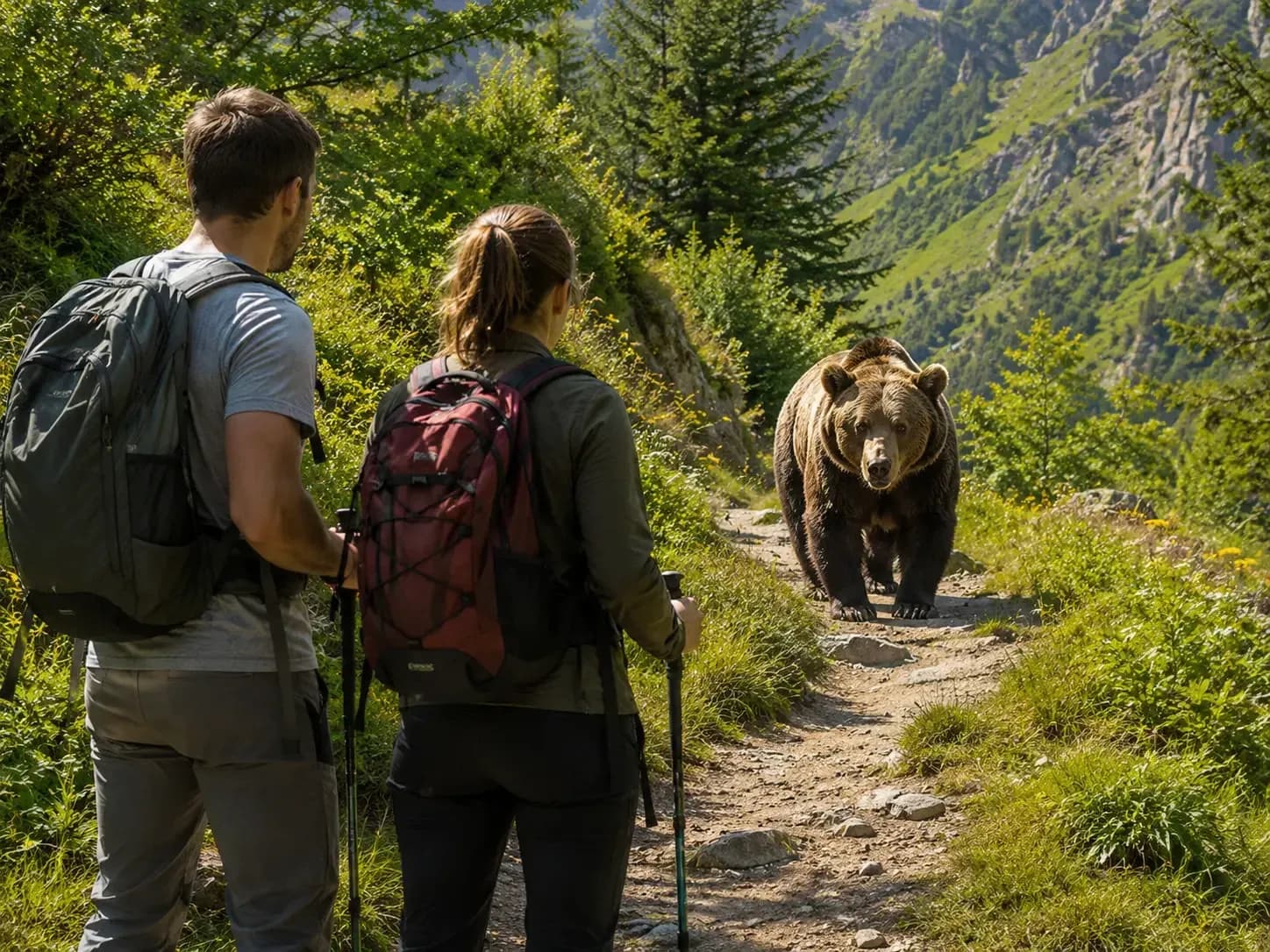
Quick quiz: a bear on the trail

If the bear is right there after all
The cardinal rule: never run. A bear reaches up to 60 km/h, escape is impossible, and fleeing triggers the animal's chase instinct. Keep your distance, a comfortable one for the animal being about 100 metres. Back away slowly the way you came, without turning your back on the bear and without looking it in the eye: to any wild animal a fixed stare means an attack is coming.
Two things frighten people for nothing. A bear up on its hind legs is not about to attack: it rises to look around and work out what the shape in front of it is. And a bear walking towards you is usually just short-sighted and coming closer for a better look. Once it works out that it is facing a human, it goes about its business. If, however, it has seen you, is not leaving and is plainly curious, the national park advises driving it off with a loud shout.
Show that you are a human, not prey: "make yourself bigger", stand tall, lift your backpack above your head and speak in a calm, confident voice. If the animal comes closer, a sharp noise helps: banging a mug against a pot, rustling a bag, a signal flare. As you withdraw, keep the wind in mind, because a bear's nose picks up food a hundred metres off. You must not throw stones or sticks at the bear, or turn your back on it when it is at its food.
If you are facing a female with cubs, this is the most dangerous encounter of all. Don't coo over them, don't approach, don't reach for your phone. Slowly and silently open up the distance and leave. The reserve's own rules put it harshly: "In defending a cub, a mother bear will not stop to warn you. She will try to kill you."
The reserve describes the worst case too, and it is better read at home than on the trail. If you cannot distract the animal, lie face down or curl into a foetal position, lock your hands behind your neck and protect your head, play dead and stay still until the bear has genuinely gone. If it starts mauling you, fight back and aim for the eyes. On the reserve's routes, to repeat, it has never come to that.
Have there been bear attacks in Krasnaya Polyana
The short answer: there is no confirmed attack on a human in the Caucasus Nature Reserve. The reserve's own wording is more careful and more honest than the newspapers': the tally of damaged tourist property grows every season, while no unprovoked attack by a bear on a human has been recorded.
There was one loud story all the same. In September 2021 the media reported a bear attack on hikers on route no. 13, the one running from the village to Lake Zerkalnoye. By one participant's account, the group set out in the evening, failed to reach the camp before dark and spent the night on the trail itself. In the morning two of them turned back, met bears twice, retreated from them not along the trail but across a difficult slope, and took refuge in a tree. The two then lost each other, and one man disappeared.
State inspectors checked the supposed site and found no signs of a struggle, no rucksacks and no belongings. Other facts emerged as well: the group had not been on the equipped route but on a dangerous trackless slope, had camped away from a designated site, and the missing man appears not to have held a permit at all. The reserve's conclusion was that one person's account makes it impossible to establish what actually happened.
Here is what follows for the trail. The real risk looks more modest: a torn tent and stolen food. And even that grows in exactly the places where the rules are broken: walking after dark, leaving the equipped trail, camping away from a designated site.
If you see a bear near houses, on a road or at the bins, call 112, the single emergency line takes calls around the clock. Sochi National Park also asks you to write to forest_sochi@npsochi.ru: on such reports the case is logged, advice is given and deterrence work is planned.
It sounds grave, but recall how we began: there have been no confirmed attacks in the reserve. These rules exist precisely so that it stays that way. How the climb itself works is set out on the route to the cornice page, the other risks of the way are gathered in the article "Trail hazards", and the bear as part of the ecosystem is covered in the wildlife overview.